Wednesday, July 04, 2007
For Sale
 Our sabbatical year in Montevideo is coming to an end and it's time for us to look for a buyer for our car. It's a 1992 Nissan Sunny with about 60,000 miles on it. (Odometer is currently just over 100,000 kilometers). Four door, gasoline engine, light blue (or celeste, as they say here). Manual transmission. We never got around to installing a radio.
We've driven it throughout the country without any problems except when we bought bad gasoline (which caused it to sputter and stall alarmingly, but had no lasting effects.)
update: Sold it.

Thursday, June 28, 2007
Mobile advertising
 Rolling billboards are common in Montevideo. We see them a lot on the Rambla-- either parked along the side or moving down the road. My favorites are the bike-powered billboards, which make a lot of sense given the price of gasoline in Uruguay.
Labels: business, cars, Uruguay
Thursday, May 24, 2007
Good Samaritans
We had some minor car trouble on our way home from Lavalleja and I'd like to thank Cesar Sosa and his family for their assistance. They graciously stopped to help us and then drove behind us in case we had more problems. At Minas, they made sure we got to a service station and aided in the consultation with the attendant. Muy amable!
It seems we had some bad gasoline and putting in an additive/cleaner and filling the tank took care of the problem. Our car has been running fine ever since.
Cesar and his wife are realtors specializing in country properties. If you're interested you can visit their website.
It seems we had some bad gasoline and putting in an additive/cleaner and filling the tank took care of the problem. Our car has been running fine ever since.
Cesar and his wife are realtors specializing in country properties. If you're interested you can visit their website.
Labels: cars, interior, Uruguay
Thursday, May 10, 2007
Estacionamiento tarifado
 Most of the streetside parking in Montevideo is free-- requiring just a tip for the cuidacoche-- but some streets, particularly in the Ciudad Vieja and the Centro require payment. These are marked by a round sign with a big letter E above the word tarifado.
 The system seems a little complicated. First you find a parking spot. Then you look for a kiosko or a store that sells fichas for the parking machines. These cost about a dollar each and buy 30 minutes of parking. (The time per ficha varies with the zone.) Then you look for a machine and use the fichas to buy a little ticket that you put on your dashboard. (Sometimes you need to try second machine because the first one is broken.)
 The city government plans to extend this system to other neighborhoods, like Pocitos, where the street parking is congested. The price mechanism does seem to prevent overcrowding-- when I went to the old city for lunch yesterday, I was the only one parked on the entire block.
Labels: cars, government, Uruguay
Monday, March 05, 2007
Gran Premio del Uruguay
 The Gran Premio del Uruguay 4ta. Edición – 19 Capitales – Histórico road rally completed their 4th stage in Montevideo, Sunday night. The cars were all antiques, going back to the 1920s. They competed in various classes, but nearly all the cars I saw were very small. The rally, sponsored by El Automóvil Club del Uruguay, went to the capitol city of each of Uruguay's 19 departamentos.
Wednesday, February 07, 2007
Acclimization
 When I first arrived in Uruguay, the old cars and trucks really grabbed my attention and I snapped a lot of photos. The antique vehicles marked Montevideo as someplace different. Now I hardly notice them, but every once in a while they do catch my attention again.
A few days ago, while waiting for a bus, I saw one and shot this ten second video.
Wednesday, November 01, 2006
Nuestro auto
Our "new" car is a 1992 Nissan Sunny. It's a little bigger than most of the cars here, so it feels roomy. It must use more gasoline, as well. We bought some gas yesterday--500 pesos worth of nafta. I think it will cost between $60 and $70 US to fill the tank.Before buying the car, an escribana did a historia for it, which is something like a title search. (Escribano is translated as notary public, but they seem more like paralegals.) The license plate belongs to the car, so we didn't need to change that. We did get the libreta, which is like an ID card for the car and the matricula which is like the registration.
There are a lot of interesting cars on the streets here (see this post), but we didn't look at any antiques.
update:I was wrong about the gas costs-- I never put in more than 1000 pesos ($40 US) to fill the tank, even when gas prices increased.
Monday, September 11, 2006
Streets of Montevideo
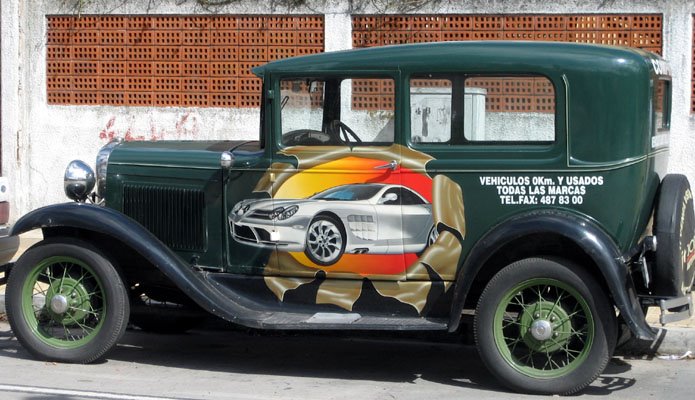
Uruguay has something of a reputation for classic cars. For years, vintage cars were used as everyday transportation. Most cars today are modern small cars-- Fiats, Citroens, Peugeots, Fords, Kias, Subarus, Hyundais, etc. The original VW beetle is fairly common. Many of the models aren't sold in the US-- subcompacts like the Cheverolet Corsa or Ford Ka. The police cars are small. The taxis are small. There are a few SUVs, but I would see more SUVs parked at the gym in Michigan than I see a in week here. A Honda Accord looks like a big luxury car compared to the typical cars on the road.
There still are some older cars on the street. Some are fully restored and advertise businesses. Some are in private collections. Others are just regular cars. I've seen several big US cars from the 1950s modified with roof racks so they can haul large items. Some of the most impressive vehicles are the old trucks used for the farmers' markets. Some look like they've been in use since WWII.
If you're interested, here's an album of my Montevideo car photos. These earlier posts are related: older car photos, some articles on antique cars in Uruguay
Saturday, July 01, 2006
On the streets of Montevideo
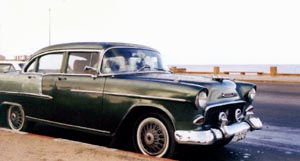


These weren't show cars, but regular means of transportation. (Summer 1998)
Friday, June 30, 2006
Old Cars
Before my first trip to Uruguay, I'd heard stories about the antique cars used as daily drivers. My wife had visited earlier and remembered cool cars from the 1920's, 1930's, 1940's and 1950's everywhere. In 1998, when I visited, there were still some on the streets but not many.
Some writers try to explain this using Uruguay's economic trajectory-- a rich country that became poor and could no longer afford to import new cars. As an economist, I know it would be cheaper to import a newer used car than to continuously retrofit cars for 70 years.
Trade policy is a more believable explanation. Make it illegal to import any cars in a country that doesn't produce automobiles and you have the incentive for a national auto-restoration industry and a living auto museum.
Relaxing that policy allowed new cars into the country. Owners of the classic cars could then sell them to overseas collectors and purchase a modern reliable auto. Eventually the government put restrictions on exporting the antiques.
Classic cars, once common throughout Uruguay, dot the cobblestone streets of Colonia del Sacramento's old Portuguese quarter San Francisco Chronicle Oct 2005
Sleepy Uruguay races to rescue its vintage cars Motoring Feb 2005
Uruguay's Treasure Trove on Wheels Los Angeles Times May 1998
Some writers try to explain this using Uruguay's economic trajectory-- a rich country that became poor and could no longer afford to import new cars. As an economist, I know it would be cheaper to import a newer used car than to continuously retrofit cars for 70 years.
Trade policy is a more believable explanation. Make it illegal to import any cars in a country that doesn't produce automobiles and you have the incentive for a national auto-restoration industry and a living auto museum.
Relaxing that policy allowed new cars into the country. Owners of the classic cars could then sell them to overseas collectors and purchase a modern reliable auto. Eventually the government put restrictions on exporting the antiques.
Classic cars, once common throughout Uruguay, dot the cobblestone streets of Colonia del Sacramento's old Portuguese quarter San Francisco Chronicle Oct 2005
Sleepy Uruguay races to rescue its vintage cars Motoring Feb 2005
Uruguay's Treasure Trove on Wheels Los Angeles Times May 1998
archives
- June 2006
- July 2006
- August 2006
- September 2006
- October 2006
- November 2006
- December 2006
- January 2007
- February 2007
- March 2007
- April 2007
- May 2007
- June 2007
- July 2007
- August 2007
- September 2007
- October 2007
- February 2008
- March 2008
- April 2008
- May 2008
- July 2008
- August 2008
- September 2008
- October 2008
- February 2009
- April 2009
- July 2009
- December 2009
- April 2010
- February 2012
- March 2023
- April 2023
- February 2026


