Saturday, August 25, 2007
Declaración de la Independencia Nacional
 On August 25, 1825 Uruguay signed its declaration of independence from Brazil on a high rock (la Piedra Alta) overlooking the Santa Lucía Chico river at Florida. Years earlier Artigas had a led a successful independence fight from Spain but afterwards Portugal annexed the territory to Brazil. The 1825 struggle eventually led to Uruguay's independence.
Labels: Colonial, government, holidays, Uruguay

Saturday, June 30, 2007
At the Ambassador's
 Last August when we were packing to come to Montevideo, my wife said, "be sure to bring a suit for when we're invited to tea with the Ambassador." I didn't think it would happen, but today we-- along with a few hundred other Americans living in Uruguay-- did visit the Ambassador at his official residence near Parque Batlle. I didn't drink tea or wear my suit, but I enjoyed fresh pineapple juice and bagels followed by a frothy beer. The occasion was an early Fourth of July celebration highlighted by the Marine color guard presenting the flag.
Labels: government, holidays, Uruguay
Saturday, June 02, 2007
La Represa Salto Grande
 The Represa Salto Grande is a dam on the Rio Uruguay just north of Salto. Construction of the dam, a joint Argentine-Uruguayan project, started in 1974 and was completed in 1979.
We didn't have time to take the guided tour to see the hydroelectric generators inside the dam, but we drove across it into Argentina. (Both Uruguay's and Argentina's Customs facilities are on the Argentine side of the river now, so it's possible to cross the bridge without going through Immigration.) Argentinian protesters, who have closed the southernmost bridge between the countries for nearly two years, only occasionally block the bridge at Salto.
The huge reservoir behind the dam in known as Lago Salto Grande.
Labels: Argentina, government, interior, Salto, Uruguay, waterfront
Wednesday, May 16, 2007
Visas
 It's easy for US citizens to visit Uruguay-- tourist visas are free and they're valid for 90 days from arrival. We've visited Buenos Aires and Patagonia and each time we returned to Montevideo we got new visas valid for another 90 days.
 Since it had been nearly 3 months from our last trip to Argentina, it was time to visit the immigration office (in the Ciudad Vieja on Misiones street.) We tried to go yesterday afternoon, but the office closed at 2:30, so we went this morning. The process was pretty quick and painless. (It cost about $12 U.S.) The renewal is good for another 90 days and we'll be returning to Kalamazoo before it expires.
Labels: government, travel US to Uruguay, Uruguay
Friday, May 11, 2007
Recycling-- in theory
 Montevideo's municipal government installed recycling stations throughout the city. There are separate collection boxes for glass, plastic, paper, metal, and batteries. All of them have space for paid advertising on the sides.
 The system is somewhat flawed since the boxes seem randomly distributed throughout the neighborhoods. So, for instance, the one recycling box near our apartment accepts only batteries. As a result, I've only recycled two AA batteries since coming to Uruguay.
The city has been running a cute campaign to promote recycling. An old T-shirt says, "En mi próxima vida quiero ser banda presidencial. RECICLAME." [In my next life I want to be a presidential sash. RECYCLE ME.] An empty toilet paper tube says, "En mi próxima vida quiero ser billete de mil. RECICLAME." [In my next life I want to be a 1000 peso bill. RECYCLE ME.] An old plastic cup wants to be a cell phone, and so on.
I don't think I've ever seen anyone deposit anything into the collection boxes, so I'm not alone in abstaining from the official recycling system. There is another, informal system that recycles a substantial amount of Montevideo's trash. I'll post soon on recycling-- in practice.
Labels: government, Uruguay
Thursday, May 10, 2007
Estacionamiento tarifado
 Most of the streetside parking in Montevideo is free-- requiring just a tip for the cuidacoche-- but some streets, particularly in the Ciudad Vieja and the Centro require payment. These are marked by a round sign with a big letter E above the word tarifado.
 The system seems a little complicated. First you find a parking spot. Then you look for a kiosko or a store that sells fichas for the parking machines. These cost about a dollar each and buy 30 minutes of parking. (The time per ficha varies with the zone.) Then you look for a machine and use the fichas to buy a little ticket that you put on your dashboard. (Sometimes you need to try second machine because the first one is broken.)
 The city government plans to extend this system to other neighborhoods, like Pocitos, where the street parking is congested. The price mechanism does seem to prevent overcrowding-- when I went to the old city for lunch yesterday, I was the only one parked on the entire block.
Labels: cars, government, Uruguay
Friday, May 04, 2007
Universidad de la Republica
 Education is part of Uruguay's constitution and the country has a long history of public education. The Universidad de la Republica is the country's largest university with over 70,000 students. It doesn't have the large campus typical of US universities but rather individual facultades throughout the city. As a public institution, tuition is free.
Labels: education, government, Montevideo places, Uruguay
Thursday, April 19, 2007
19 de abril
 April 19th commemorates the Desembarco de los 33 Orientales when Uruguay's independence fighters, led by Juan Antonio Lavalleja, landed at the Playa de la Agraciada on the banks of the Río Uruguay. Uruguay, after successfully rebelling against Spanish rule, was invaded by Portugal and had been annexed to Brazil in 1821 so the struggle for independence continued.
This date marks an important point in Uruguay's history. It's still celebrated as a holiday, but the actual day of vacation is Monday so people can enjoy a long weekend.
Labels: Colonial, government, holidays, Uruguay
Monday, January 22, 2007
Another Sunday in Pocitos
 Pocitos beach is really full of people now. (Compare to this photo from October.) Sunday is still the most popular day, but every sunny day brings crowds. There are more structures on the beach, too. Lifeguard stations were the first to be erected, followed by porta-potties. The ministry of sports brought volleyball nets, soccer goals, a stage, and a small soccer stadium.
Labels: government, Montevideo places, Uruguay, waterfront
Saturday, January 20, 2007
Murga
 Los Mareados played a free concert at Punta del Diablo last Saturday. Because of the strong winds they couldn't sing on the beach, so they set up a couple of kilometers inland, right across from our hotel, Hostería del Pescadores. That made it very convenient for us. It was part of a music series sponsored by Uruguay's Ministry of Tourism and Sport.
Murga is a very popular type of music in Uruguay, particularly during Carnival season. Murga groups often wear elaborate make-up and costumes for their performances. I expect to see more murga during the next couple of months.
Here's a short video of Los Mareados:
Labels: carnival, customs, government, interior, murga, music, Rocha, Uruguay, video
Friday, December 15, 2006
Tax closures
Uruguay's tax authorities closed 22 businesses throughout the country yesterday, including one of our favorite restaurants. Most of the businesses will be closed for 6 days. This morning's El Pais quotes a tax official, "As the saying goes, when you see your neighbor's beard burning, put yours to soak." [my translation*] Academics call this the demonstration effect, but I like the burning beard better. The IRS uses the same strategy with high-profile tax-evaders (Willie Nelson comes to mind.)
*Here's the original quote:
"Queremos decir que, como dice el dicho, cuando veas las barbas de tu vecino arder, pon las tuyas en remojo."
*Here's the original quote:
"Queremos decir que, como dice el dicho, cuando veas las barbas de tu vecino arder, pon las tuyas en remojo."
Labels: business, government, Uruguay
Thursday, November 30, 2006
Design Flaw
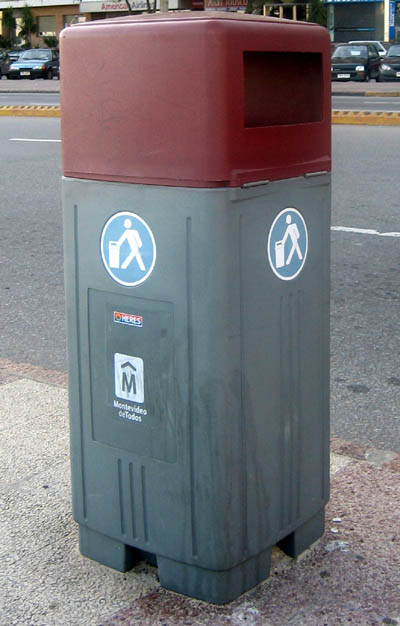 These trash cans are placed at regular intervals on the broad sidewalk between the Rambla and Pocitos beach and Buceo harbor in Montevideo, Uruguay. As trash cans go, I think they are rather handsome. People do seem to use them, although there is still litter on the beaches to be cleaned up by the city crew.
There is a problem with the design-- not the style, but the material. The plastic isn't heat resistant, or at least it isn't fireproof. I'm not sure if the fire comes from cigarettes accidently discarded in bins full of paper, or if the fire comes from deliberate vandalism, but as you can see in the second photo, the side of a bin melted, leaving a big hole.
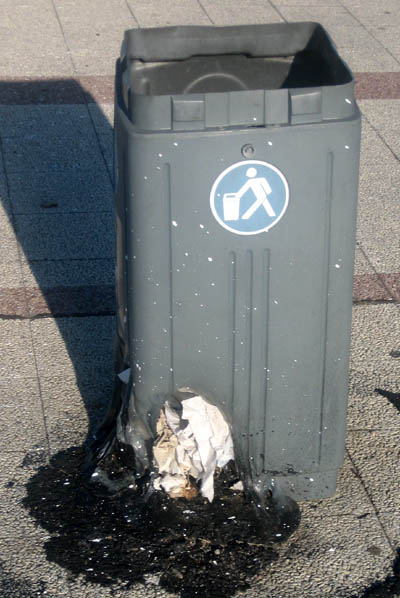
This trash bin is still in service, and people continue to use it. Despite the hole, it more or less functions as intended.
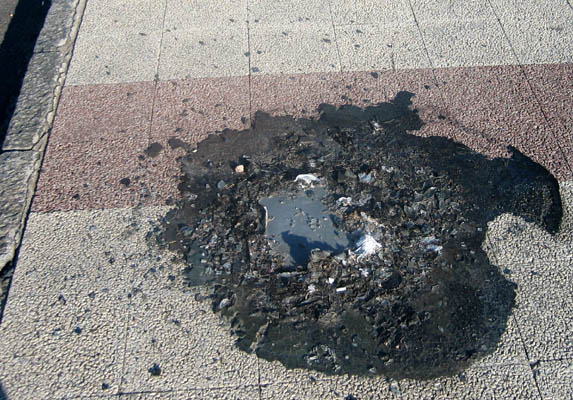 This one doesn't. This is all that's left of a trash bin that completely melted. At first, I didn't even recognize what it had been.
Labels: government, Uruguay
Friday, October 27, 2006
Rumors
The Latin Americanist: Dubya bought land in Paraguay, says L. American press
I'd heard rumors a couple of weeks ago, here in Uruguay, that George W. Bush was planning to go into exhile in Paraguay after he left office. Apparently those rumors are widespread
Rumors have appeared over the past week alleging that George W. Bush purchased 100,000 acres of land in northern Paraguay near the border of Brazil and Bolivia. The rumors started with daughter Jenna Bush’s diplomatic visit earlier this month with UNICEF where she also met with Paraguay’s president.
I'd heard rumors a couple of weeks ago, here in Uruguay, that George W. Bush was planning to go into exhile in Paraguay after he left office. Apparently those rumors are widespread
Labels: government, Uruguay
Friday, October 06, 2006
Ficha Medica
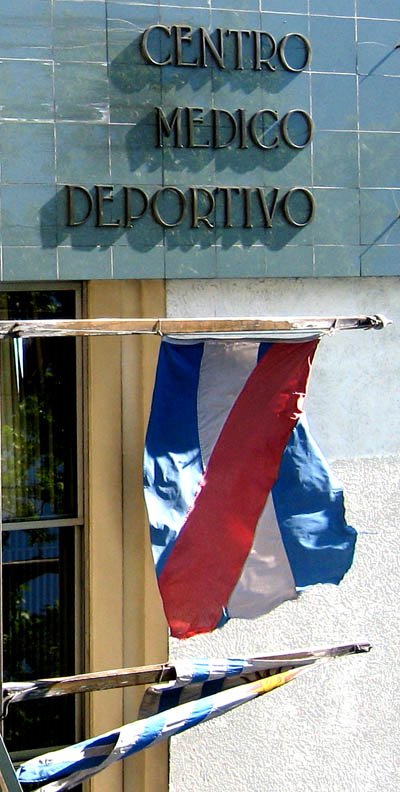
A ficha medica is required to compete in any sport in Uruguay, from fútbol to competitive fishing. The cards are issued by the Centro Médico Deportivo, part of the national sports and tourism ministry. My daughter needed one before she could play soccer. She had her appointment Tuesday morning and we picked up the card Friday morning. As a kid, her dental and medical exams were free. We did go to another ministry to have her US vaccination records transferred onto the Uruguayan form.
Labels: government, sports, Uruguay
Friday, September 15, 2006
Doing Business
Greg Mankiw points to a recent report from the World Bank, Doing Business.
Uruguay ranked 64th out of 175 countries in the ease of doing business. A few comparative rankings: Mexico 43rd, Dominican Republic 117th, Argentina 101st, Venezuela 164th. The top three countries were Singapore, New Zealand, and the United States. The bottom three Guinea-Bissau, East Timor, and the Democratic Republic of the Congo.
Here's an excerpt from the report on Uruguay
The data behind the rankings are interesting. It takes, on average, 43 days to start a business in Uruguay. The tax rate on gross profits is 27.6%. The cost of firing a worker is 31 weeks of wages. (Comparable figures for the US are 5 days, 46%, and 0 weeks of wages.) An interesting aside on taxes-- 9 countries, including Argentina, are reported to tax profits at over 100%.
Uruguay ranked 64th out of 175 countries in the ease of doing business. A few comparative rankings: Mexico 43rd, Dominican Republic 117th, Argentina 101st, Venezuela 164th. The top three countries were Singapore, New Zealand, and the United States. The bottom three Guinea-Bissau, East Timor, and the Democratic Republic of the Congo.
Here's an excerpt from the report on Uruguay
Uruguay
Region: Latin America & Caribbean
Income category: Upper middle income
Population: 3,463,197
GNI per capita (US$): 4,360.00
Ease of... 2006 rank
Doing Business 64
Starting a Business 134
Dealing with Licenses 56
Employing Workers 58
Registering Property 138
Getting Credit 33
Protecting Investors 83
Paying Taxes 76
Trading Across Borders 59
Enforcing Contracts 119
Closing a Business 37
The data behind the rankings are interesting. It takes, on average, 43 days to start a business in Uruguay. The tax rate on gross profits is 27.6%. The cost of firing a worker is 31 weeks of wages. (Comparable figures for the US are 5 days, 46%, and 0 weeks of wages.) An interesting aside on taxes-- 9 countries, including Argentina, are reported to tax profits at over 100%.
Labels: economics, government, Uruguay
archives
- June 2006
- July 2006
- August 2006
- September 2006
- October 2006
- November 2006
- December 2006
- January 2007
- February 2007
- March 2007
- April 2007
- May 2007
- June 2007
- July 2007
- August 2007
- September 2007
- October 2007
- February 2008
- March 2008
- April 2008
- May 2008
- July 2008
- August 2008
- September 2008
- October 2008
- February 2009
- April 2009
- July 2009
- December 2009
- April 2010
- February 2012
- March 2023
- April 2023
- February 2026


