Thursday, June 28, 2007
Mobile advertising
 Rolling billboards are common in Montevideo. We see them a lot on the Rambla-- either parked along the side or moving down the road. My favorites are the bike-powered billboards, which make a lot of sense given the price of gasoline in Uruguay.
Labels: business, cars, Uruguay

Saturday, June 23, 2007
Remate
 A few days ago some friends and I went to Castells & Castells Casa de Remates [Galicia 1069], a big auction house in Montevideo near the old train station. They went to bid on a marble dining room table and I went to watch. It was interesting to see all the different things for sale and to watch the bidders.
 I've never seriously studied auction theory but concepts like the winner's curse are intriguing.
See a short video of the auction:
Labels: business, Uruguay, video
Wednesday, June 13, 2007
Price discrimination 2
 A few months ago I posted on the difference between prescription drug prices in Uruguay and the United States. Here's a different example:
I wear a lot of casual clothes from Columbia Sportswear. They're durable, relaxed, and good for camping and traveling. In the US, I can buy a pair of Columbia pants for about $30 at Kohls. In Montevideo, there's a Columbia store right around the corner from my apartment. Same rugged outdoor clothing, but the prices are different. Instead of $30-$40, the pants cost $90 or $100.
Why such a big difference? Part of it is taxes. In Michigan the price doesn't include sales tax, so I could add a couple of dollars to adjust for that. Uruguay's IVA is higher, so it probably accounts for $20 of the price differential, but that still leaves a 100% difference. Why?
Production costs won't explain the difference-- the clothes are imports to both countries. We could look at differences in demand. But here the story becomes less simple, why charge a substantially higher price in a poorer country?
I'd suggest it has to do with an absence of competition. In the US, Patagonia dominates the high-end outdoor clothing market but they have little presence in Uruguay. That lets Columbia re-position itself locally to become the luxury outdoor brand. Rather than compete against LL Bean and Woolrich in the middle-price market segment like they do in the US, they hope to command a premium price in Uruguay. Will it work? I'm not sure. I don't see a lot of traffic in their boutique, but their pricing would allow them to profit on low volume.
Would I pay $100? No, I'm not that loyal a customer. But if I were staying here longer, they might be a pedido.
Labels: business, economics, Uruguay
Monday, April 30, 2007
Transporte de Valores
 Montevideo has a lot more armored cars than I'm accustomed to. They're constantly complicating traffic when they stop in a driving lane to make a delivery or pick-up. They're usually accompanied by a small car full of guards with big guns. I've been too intimidated to get a good photo of the guys with the shotguns and assault rifles. There seem to be two main companies and several smaller operators.
I'm fairly certain that the widespread use of cash payments explains the number of armored cars.
Thursday, March 15, 2007
Stickers
 It's very common for businesses to put advertising stickers on the rear windows of cars in Uruguay. I've had a couple appear on my car but I peeled them off. Some people like them and eventually their back window gets completely covered.
Tuesday, March 13, 2007
Street corner marketing
 Nearly everyday in Montevideo, I see young people advertising on the streets. Typically they hand out brochures, but sometimes they go beyond that. Before Christmas, Punta Carretas Shopping featured young women in silky bathrobes to promote their special all-night hours.
The guys in the picture were part of the most sophisticated campaign I'd seen. They were at a traffic light near the beach and when the light changed they would enter the crosswalk and each of them would take a drink of Coke. Then they would turn to face the cars and their shirts would spell Ahhh! Then they held up their signs, saying "El lado Coca-Cola de la frescura" [The Coca-Cola side of freshness] all before the light changed. Then they'd go back to the sidewalk and wait for the next traffic cycle.
Monday, January 22, 2007
Punta Carretas Shopping
 Punta Carretas Shopping is one of Montevideo's three major shopping malls. In most Spanish-speaking countries it would be a centro comercial but in Uruguay the prefered term is "shopping". It's a bright modern mall built inside a former prison. I usually feel a bit lost there.
 This isn't accidental. As Douglas Rushkoff notes, "today’s retail environments are selling machines engineered to extract the most money per second from your wallet. ... The first tactic is to keep people inside the mall – the longer they stay, the more they buy. The key is to disorient them." For me, the top floor of Punta Carretas is the most confusing since I can never find the single escaltor that goes down to the main floor. (The multiple escalators ascending to the top floor are very easy to find.) I usually wander around looking for an escape.
In the US, time-pressed shoppers have responded to mall design by taking their business elsewhere, particularly to the big box retailers. (Or, Big Box). Shopping mall developers, hurt by the changes in shopping habits, are building "lifestyle centers" to compete.
In Uruguay, shopping malls still seem to be something of a novelty and a luxury. Most retail is either storefronts along city streets or stalls in the open-air ferias.
Also on retailing: Malcolm Gladwell has an interesting article on The Science of Shopping
Labels: business, Montevideo places, Uruguay
Friday, December 15, 2006
Tax closures
Uruguay's tax authorities closed 22 businesses throughout the country yesterday, including one of our favorite restaurants. Most of the businesses will be closed for 6 days. This morning's El Pais quotes a tax official, "As the saying goes, when you see your neighbor's beard burning, put yours to soak." [my translation*] Academics call this the demonstration effect, but I like the burning beard better. The IRS uses the same strategy with high-profile tax-evaders (Willie Nelson comes to mind.)
*Here's the original quote:
"Queremos decir que, como dice el dicho, cuando veas las barbas de tu vecino arder, pon las tuyas en remojo."
*Here's the original quote:
"Queremos decir que, como dice el dicho, cuando veas las barbas de tu vecino arder, pon las tuyas en remojo."
Labels: business, government, Uruguay
Thursday, December 14, 2006
Cosas artesanales
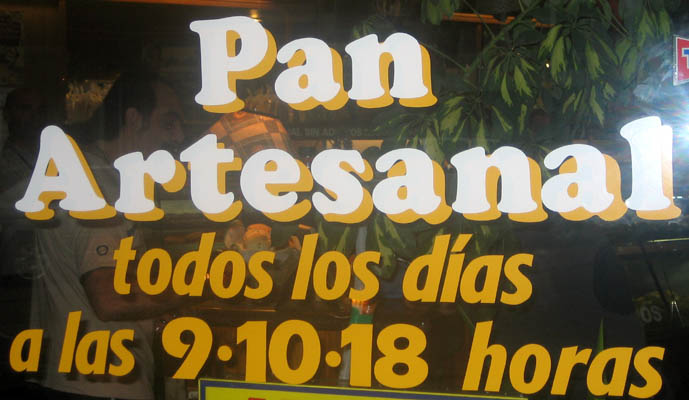
Artisan-made foods are popular in Montevideo: bread, pasta, cheese, ham, and even fish. I like supporting these small-scale producers and the quality of the products that I've tried has been very good.
Grant McCracken looks at this same trend in the US and identifies 10 reasons for the artisanal movement. Here's his first reason:
1. a preference for things that are human scale.
If once we delighted in the sheer scale of a consumer society, now we want things made in tiny batches. In the place of Morton Salt that comes from some vast industrial process, some of us prefer artisanal salt. Pam bought salt recently that came with a talkative, 4 color, brochure. Geez, I wondered, what is there to say about salt?. Plenty, apparently
I haven't seen artisanal salt in Uruguay, but I really like the breads.
Labels: business, food and drink, Uruguay
Tuesday, December 05, 2006
Camera police
A few weeks ago I was at the Géant superstore checkout. I wanted to buy a bike pump but the price wasn't on it. A clerk on rollerblades came to check the price. I thought that was pretty cool and decided to take a picture. (See this post.) Apparently, Géant prohibits photographs, so a security guard came over to scold me. Which he did, for a long time-- continuing through several of my apologies. I wasn't particularly happy and I didn't buy the bike pump.
Think a bit about this policy. A customer at a store sees something interesting & decides to take a photo to share with his friends and family. "Hey cool store, check it out!" Isn't this exactly what a store is trying to accomplish through advertising? I understand that a business has the right to restrict photography on its property, but are those restrictions in its own interest? Seth Godin, a marketing expert, had the same thing happen to him. You can read his thoughts on it.
Anyway, I still shop at Géant but every single time I walk in the door I get a bad feeling. If there was another superstore in Montevideo, I'd shop there instead.
Think a bit about this policy. A customer at a store sees something interesting & decides to take a photo to share with his friends and family. "Hey cool store, check it out!" Isn't this exactly what a store is trying to accomplish through advertising? I understand that a business has the right to restrict photography on its property, but are those restrictions in its own interest? Seth Godin, a marketing expert, had the same thing happen to him. You can read his thoughts on it.
Anyway, I still shop at Géant but every single time I walk in the door I get a bad feeling. If there was another superstore in Montevideo, I'd shop there instead.
Chicas Peligrosas
 The "dangerous chicas" are part of a marketing campaign for AXE. They were on the Rambla the other day for some kind of promotion. Guys on the beach had a chance to ask questions and win prizes (AXE products) but I couldn't quite figure out the format. Unilever, who also makes Hellmanns, is using similar marketing for AXE worldwide.
Tuesday, November 21, 2006
Camels on the Rambla
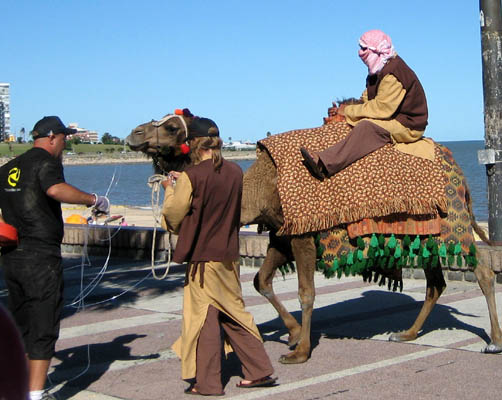 They are filming on the Rambla again. This seems to be a bigger production than the earlier one. Trucks full of props and equipment line both sides of the street. They closed several driving lanes causing traffic to back up for blocks. They also roped off a large section of beach and outfitted it with beach umbrellas (uncommon on this beach) and extras in bathing suits.
 Yesterday afternoon, they were filming this camel. A life-sized camel dummy sprawled on the sidewalk off-camera and a nearby truck held a spare camel. The crew is back this morning, but I haven't seen the camels.
Tuesday, November 14, 2006
Price check
I liked this alternative technology for checking prices at a supermarket in Montevideo. See the price check video.
Labels: business, Uruguay, video
Monday, October 30, 2006
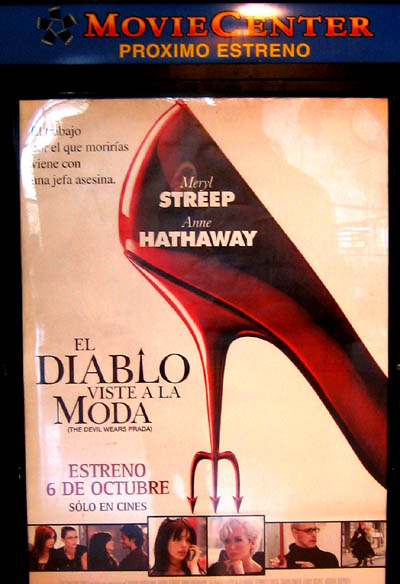
Made in USA
A comment on an old post on the From Uruguay blog got me thinking.
As an economist, I know this statement isn't true. Imports are only about 14% of US national income. In the US, most spending is on US-produced goods and services. European countries, by comparison, spend substantially more on imports: France 24%, Germany 29%, Spain 27%. It’s true that imports have increased in recent decades, but the US is still a domestically-focused economy.
Living in Uruguay, when I read the comment, made me realize how few US-made products are available here. While I can buy lots of US brands, they are manufactured in other countries: Oreo cookies from Argentina or Coca-Cola bottled in Uruguay. Kellogg’s cereal, Lay’s potato chips, Ford cars, Budweiser beer, and M&M candies are all available in Montevideo, but they aren’t imported from the US. They are produced by foreign subsidiaries of the US companies.
I started looking, in Uruguay, for products made in the US. I ran into many other familiar brands: Canon, Nestlé’s, Hellman’s, VW, SONY— but these aren’t even US brands, just well-known global brands. There’s a Nike shop selling sneakers at the mall, but Nike outsources all of its manufacturing, so I didn’t even look for a “Made in USA” label there. The old cars on the streets— a 1968 Dodge Polara, Pre-WWII Chevy trucks, Ford Model A’s— may have been produced in the US, but that’s economic history. I wanted to find something produced in 2006.
This sign at the shopping mall woke me up. I’d been making the same mistake the anonymous commenter made— thinking inside the box. Huge amounts of what we consume aren’t physical things and they don’t come in boxes. Everyday, I see US shows on Uruguayan TV. The theaters in Montevideo show the latest Hollywood releases. There are US banks throughout the city. Of course this is true in the US as well. Walk into a Walmart and you could get the impression that the US doesn't make anything. But we spend more on housing, education, and entertainment than we do at Walmart. Former Fed chairman, Alan Greenpan spoke famously about the "dematerialization" of the US economy. While, I wouldn't want to push this too far, it is important to remember that not everything of value fits in a shopping bag.
Anonymous said...
Another good thing about an FTA with the states for Uruguay is that hardly any products are made in the US any more. We buy everything from other places, mostly China...
As an economist, I know this statement isn't true. Imports are only about 14% of US national income. In the US, most spending is on US-produced goods and services. European countries, by comparison, spend substantially more on imports: France 24%, Germany 29%, Spain 27%. It’s true that imports have increased in recent decades, but the US is still a domestically-focused economy.
Living in Uruguay, when I read the comment, made me realize how few US-made products are available here. While I can buy lots of US brands, they are manufactured in other countries: Oreo cookies from Argentina or Coca-Cola bottled in Uruguay. Kellogg’s cereal, Lay’s potato chips, Ford cars, Budweiser beer, and M&M candies are all available in Montevideo, but they aren’t imported from the US. They are produced by foreign subsidiaries of the US companies.
I started looking, in Uruguay, for products made in the US. I ran into many other familiar brands: Canon, Nestlé’s, Hellman’s, VW, SONY— but these aren’t even US brands, just well-known global brands. There’s a Nike shop selling sneakers at the mall, but Nike outsources all of its manufacturing, so I didn’t even look for a “Made in USA” label there. The old cars on the streets— a 1968 Dodge Polara, Pre-WWII Chevy trucks, Ford Model A’s— may have been produced in the US, but that’s economic history. I wanted to find something produced in 2006.
This sign at the shopping mall woke me up. I’d been making the same mistake the anonymous commenter made— thinking inside the box. Huge amounts of what we consume aren’t physical things and they don’t come in boxes. Everyday, I see US shows on Uruguayan TV. The theaters in Montevideo show the latest Hollywood releases. There are US banks throughout the city. Of course this is true in the US as well. Walk into a Walmart and you could get the impression that the US doesn't make anything. But we spend more on housing, education, and entertainment than we do at Walmart. Former Fed chairman, Alan Greenpan spoke famously about the "dematerialization" of the US economy. While, I wouldn't want to push this too far, it is important to remember that not everything of value fits in a shopping bag.
Labels: business, economics, Uruguay
Friday, October 13, 2006
The check still isn't in the mail

More bills to pay, but Redpagos payment centers [see this post] aren't for all the bills. Today I had to pay gastos comunes (condo fees), the Montevideo "door tax", and the phone/Internet bills. These are all paid, in cash, at the Abitab office, just up the street. I'm not sure why there are two payment networks, but I noticed one difference. At Redpagos, you can exchange dollars for pesos. At Abitab, you can buy lottery tickets.
Labels: business, economics, Uruguay
Monday, October 02, 2006
The check is in the mail...
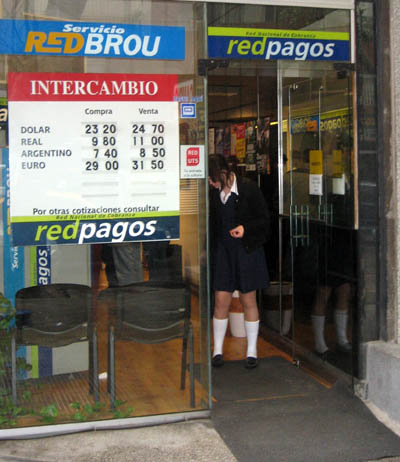
Of course, the check isn't in the mail. I'm not sure what excuse gets used for delinquent payments in Uruguay, but it's not that one. Checks have weak legal status here and I get the impression that the mail service isn't widely used.
It's the beginning of the month and we had a few bills to pay and no checks. Fortunately, Uruguayans have developed alternative payment systems. Rent gets paid in-person, in cash, at the real estate office around the corner. Utility bills are paid, in cash, at any payment office, which are on nearly every block in our neighborhood. Redpagos is one of the major payment networks. (See their website for an example of truly gratuitous computer graphics.) The process is easy enough but it does take longer than writing a check and it seems like their processing costs would be substantially higher. It is possible to arrange for automatic electronic bill-paying from a bank account.
We do have a bank account here but it wasn't easy to get. In Kalamazoo, we have an account at LaSalle Bank which is owned by ABN-AMBRO which has branches all over Montevideo, so we thought that might be easiest, but no. Then we tried Citibank, Bank of Boston, etc, with no luck. It turns out that some part of the Homeland Security laws in the US makes it nearly impossible for a U.S. citizen to open a bank account overseas. (Apparently the US government believes that suitcases full of $100 bills are preferable to bank-to-bank transfers.) We eventually opened an account with a Spanish bank.
I'm not used to dealing with so much cash. Signing a lease requires four month's rent as a security deposit, plus the first month's rent, plus another month's rent in commission to our real estate agent. All in US dollars. I've never had so much cash on the table.
Friday, September 29, 2006
Delivery

Elevators here are typically small. Our elevator holds five passengers, if they're friendly. (For my Kalamazoo College readers-- it's about the size of the elevator in Dewing Hall.) Some are smaller. When we arrived with our 6 suitcases, we had to take two trips. This points to a more general problem-- how does furniture get delivered? On the outside!
This queen mattress was being delivered to an apartment on our block. One worker attached the ropes and then joined his partner up on the sixth floor. The two guys just hauled the mattress up and pulled it in the window.
See a little movie of this here: http://www.youtube.com/watch?v=KqsR1IIbqgg
Labels: apartments, business, Uruguay, video
Thursday, September 21, 2006
Hellmann's
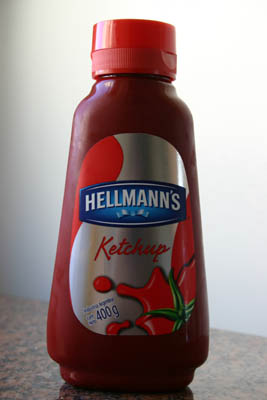
Many familiar brand names are available in Uruguay. Coke and Sprite are the most popular refrescos; Doritos and Lay's potato chips are prominent snacks; and Hellmann's is the leading ketchup.
Ketchup? In the US, Hellmann's is synonymous with mayonnaise. (See www.mayo.com, for instance.) I'd never even heard of Hellman's ketchup before arriving here. Every restaurant seems to serve it and it's the dominant brand at grocery stores. The only place I've seen Heinz ketchup in Uruguay was at the US trade exhibit at the Expo.
Hellmann's ketchup nicely illustrates the global economy. Hellmann's is a well-known US brand, started by a German immigrant in New York City in 1905 . The ketchup sold here in Uruguay is produced in Argentina. Unilever, the Anglo-Dutch food and soap giant, owns Hellmann's and markets its products worldwide. Multinational ketchup!
Labels: business, economics, food and drink, Uruguay
archives
- June 2006
- July 2006
- August 2006
- September 2006
- October 2006
- November 2006
- December 2006
- January 2007
- February 2007
- March 2007
- April 2007
- May 2007
- June 2007
- July 2007
- August 2007
- September 2007
- October 2007
- February 2008
- March 2008
- April 2008
- May 2008
- July 2008
- August 2008
- September 2008
- October 2008
- February 2009
- April 2009
- July 2009
- December 2009
- April 2010
- February 2012
- March 2023
- April 2023
- February 2026