Friday, April 07, 2023
Argentine pesos

It's not always this way, but the value of the Argentine peso is falling faster than prices inflate so nearly everything here is a bargain for anyone with foreign currency.

In Uruguay, everyone had their trusted exchange guy in Buenos Aires-- a taxi driver, a white-haired man operating next to a florist, a guy who would deliver pesos to your door-- and they were happy to share their contacts. We have been changing money at the black market rate in an office on a big commercial street-- complete with two teller windows, marble floors, frosted glass dividers, velvet ropes between chromed stanchions, and bill-counting machines. It's not secret-- there is a big lighted sign above the entrance and the name is etched on the glass double doors. Apparently the black market is fairly grey.
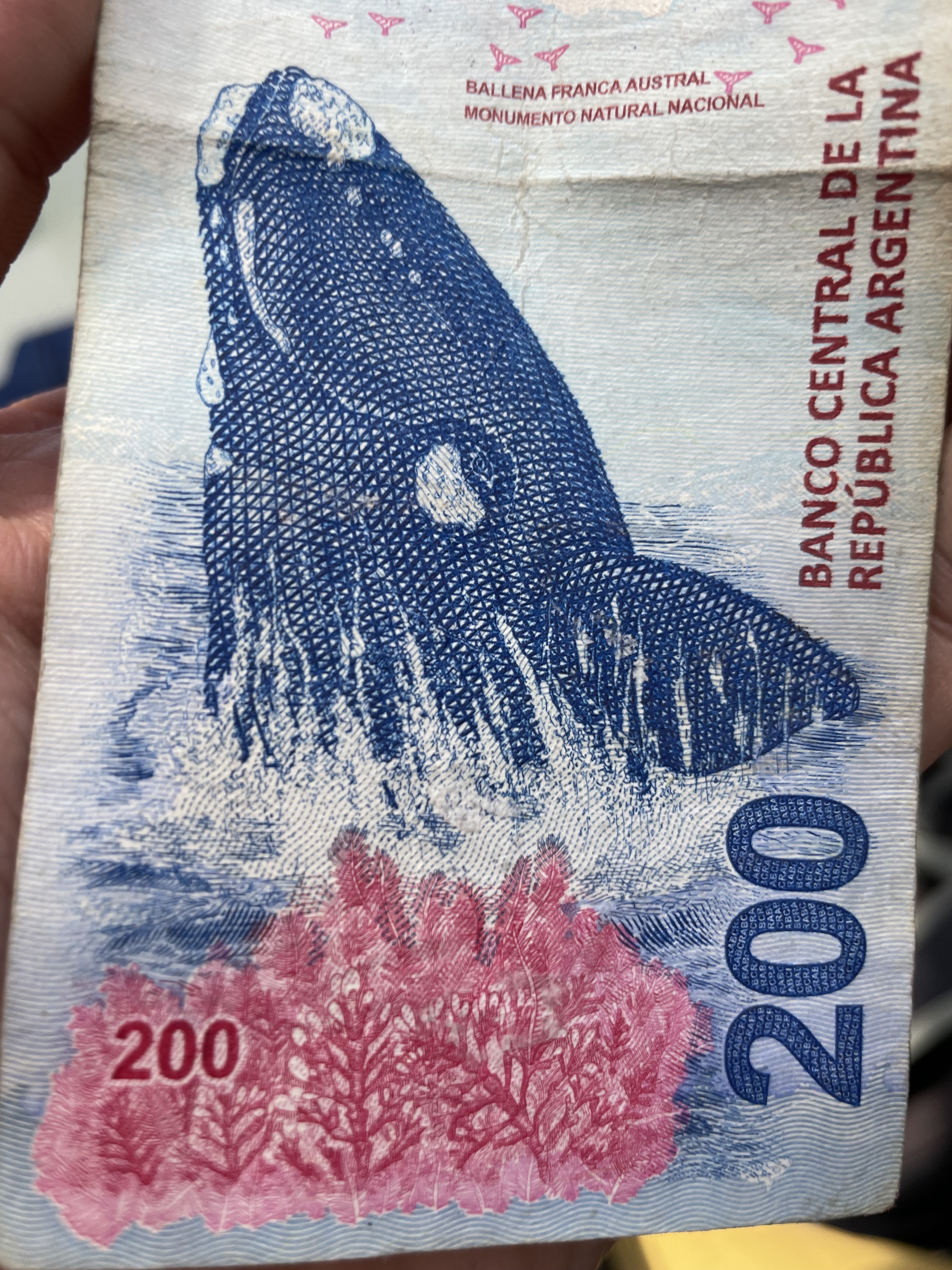
The biggest bill in circulation is 1000 pesos-- only worth $2.50 US-- so paying for a hotel requires bundles of bills. Even buying dinner means counting stacks of dozens of notes. The smaller bills (10, 20 pesos) have so little value that they are often ignored at cash registers. Western Union was running short of 1000 peso bills, so customers were stuffing thick wads of 100 peso and 500 peso notes into pockets, purses, and paper bags that held the croissants they ate while waiting in line. An inch thick stack of 100 peso bills makes you feel rich, but its only worth about $25.
While Argentine products are super-cheap now, imports are really expensive here. A bottle of maple syrup cost over $70 at the official exchange rate. Ordinary salmon from Chile costs 4 times as much as prime Argentine streak. My wife is particular about coffee and much of the South American coffee doesn't meet her standards (wrong beans, processed with sugar) so she looked for imported coffee in the supermarket but it was simply unavailable. The same exchange rate that makes Argentina a bargain for us, makes imported good prohibitively costly.
Inflation is currently running over 100% annually. Many restaurants cover the old prices with stickers rather than re-print the entire menu. We ate a Don Julio, a famous steakhouse, and received menus with two different prices-- one was from last week and prices had already changed. We took the Mitre train to Tigre (about an hour's ride)-- a comfortable modern train-- and it cost 25 pesos, about 6 cents. Apparently government-set prices don't adjust as quickly as restaurants.

As a traveler, the huge difference between the black market and official exchange rates means you need to manage your cash carefully. Withdrawing from an ATM is at the official rate-- doubling your costs. Credit cards may exchange at the official rate or at a special tourist rate (close to the black market rate) but it's impossible to know at the time of a purchase. There isn't much dollarization (it may be illegal) so cash transactions in pesos are the norm. This means regular trips to a change dollars. There is a strong preference for crisp, clean US $100 bills. Worn currency or smaller bills may trade at a discount or be rejected entirely.
But, it's important not to exchange more than you will spend, since you can't change the pesos back into dollars. (Everyone wants dollars and no one wants to hold pesos.) The value of the peso is dropping quickly so they are likely to be worthless for travel in future years. Pretty much use it or lose it.


Saturday, May 17, 2008
Ushuaia
 In February, 2007 at the height of the southern summer, we flew a few thousand kilometers south from Montevideo to visit Ushuaia, "el fin del mundo" [The End of the World]. This Argentine city is further south than any other in South America. The end of the continent isn't abrupt; instead, the Beagle Channel runs through a series of mountainous islands. (There's a Chilean naval base on one that can claim the continent's southernmost habitation.) Whether in Chile or Argentina, the region is known as Tierra del Fuego.
It's a very interesting place and I'd like to go back again. Unfortunately, our summer is their winter and it must be pretty desolate then.
Between other destinations in Patagonia and carnaval events back in Montevideo, I never posted more than a few photos. I finally had a chance to put together a video slideshow from that trip.
You can see it here:
Labels: Argentina, nature, Patagonia, video
Sunday, April 27, 2008
Buenos Aires
 Although Montevideo isn't far from Buenos Aires, we didn't make the trip across the Rio as often as I expected. We did visit the bigger city a couple of times (and flew in and out a few more.) It's an interesting place.
Here's a video slideshow of some of my photos from Buenos Aires:
Labels: Argentina, Buenos Aires
Sunday, July 29, 2007
Iguazu Falls

Sunday, July 15, 2007
Safari
 Since we didn't have a visa for Brazil, we had a free day in Iguazu so we went to the tourist office and said we'd like to see more of the selva. We were in luck, they told us, since a 4x4 tour was leaving in an hour. We grabbed some sandwiches and climbed into a rugged truck and headed out of town. Minutes after turning onto the red dirt road we were at the edge of the jungle and we passed little farms cut from the surrounding forest. As we drove, the guide explained the afternoon's events and my wife expressed her surprise. We thought we'd be taking a drive through the woods looking for toucans, coatis, or monkeys but the plan was somewhat more adventuresome.
We started by strapping on climbing harnesses, followed by a short walk through the jungle to a cliff. There, we hooked onto a climbing rope and rappelled down the cliff.
This was a new experience for all of us, and the prospect was a little scary. The actual rappel was pretty easy & we all enjoyed it afterwards. Next was a walk through the woods, crossing above a small waterfall, and eventually reaching a panoramic view across the Rió Paraná to Paraguay.
Then we climbed several storeys into a huge old tree using a rustic staircase. There we clipped our harnesses to a zip-line, grabbed its handles and took off through the canopy. We accelerated over the treetops, using the brakes only when we reached the landing-- halfway down another forest giant. Then up more stairs to another cable, another "flight" and then a third. Very cool!
See a short video:
Labels: Argentina, nature, sports, video
Saturday, July 14, 2007
Coati
 Coatís, along with toucans, are the symbol of Iguazú. While we didn't see any toucans, we did see over a dozen coatís. Most of the other animals in the selva avoid people, but coatís have learned to associate tourists with food. Since they're active during the day and unafraid of people, they're easy to see. We enjoyed watching a family cross a little waterfall on a vine.
Coatís are relatives of the raccoon.
Friday, July 13, 2007
Cataratas de Iguazu
 The Cataratas de Iguazú competes with Niagara Falls and Victoria Falls for the title of "world's largest waterfall". Actually all three have legitimate claims: Niagara has the most water, Victoria is the highest, and Iguazú is the widest.
Iguazú is in Northern Argentina bordering Brasil and very close to Paraguay. It's a 2 hour flight from Buenos Aires or a 20-some hour bus ride.
The falls are impressive! They're much harder to photograph than Niagara because there are so many individual falls that it's impossible to get them all in the same frame. Brasil and Argentina each have national parks around the falls, creating a large natural area. The selva is sub-tropical forest full of palm trees, philodendrons, vines-- very different from Uruguay's rangeland. Walking through the jungle to see the falls is much more interesting than crossing Niagara's asphalt.
The weather wasn't the greatest this week-- cloudy and cool-- but it beats their summer heat of 45 degrees C. We got soaking wet on the "grand adventure" boatride under the falls & that was really cold. But, the rain held off until we were on our way to the airport for the trip back to Montevideo. (And we missed Buenos Aires' first snow in 89 years by a couple of hours.)
We didn't visit the Brazilian side because the visa cost was $144 per person. I heard the views were great, but the price seemed awfully steep for one afternoon. I later heard that it's easy to cross illegally into Brazil by taxi or city bus. (But not with a tour company since they face a penalty of 4000 reales if you're caught.) In any case, we didn't have time to try being illegal aliens and we found plenty to entertain us on the Argentinian side.
Saturday, June 02, 2007
La Represa Salto Grande
 The Represa Salto Grande is a dam on the Rio Uruguay just north of Salto. Construction of the dam, a joint Argentine-Uruguayan project, started in 1974 and was completed in 1979.
We didn't have time to take the guided tour to see the hydroelectric generators inside the dam, but we drove across it into Argentina. (Both Uruguay's and Argentina's Customs facilities are on the Argentine side of the river now, so it's possible to cross the bridge without going through Immigration.) Argentinian protesters, who have closed the southernmost bridge between the countries for nearly two years, only occasionally block the bridge at Salto.
The huge reservoir behind the dam in known as Lago Salto Grande.
Labels: Argentina, government, interior, Salto, Uruguay, waterfront
Saturday, March 03, 2007
Tren del Fin del Mundo
 The End of the World Train is a narrow-gauge tourist attraction outside Ushuaia. It runs along the right-of-way of the old prison line to Tierra del Fuego National Park. You can still see the stumps left from the prisoners' efforts. The prisoners rode on open flatcars and logs were carried back to town on the same train. The current train, while simple, is substantially more comfortable.
Friday, March 02, 2007
Tropical?
 I think of flamingos as tropical birds so I was a little surprised to see them in El Calafate a few miles from the Moreno Glacier. Lago Argentina, where these birds are feeding, is fed by meltwater from the glaciers, making it too cold for me to even consider swimming.
I think these are Chilean Flamingos. There are two other species of flamingo that live in the Andes.
Labels: Argentina, nature, Patagonia
Thursday, March 01, 2007
Economic Development
 Ushuaia, the southernmost city in the world, began with a prison. At the beginning of the 20th century, Argentina built a large prison to house dangerous felons and political prisoners at the "end of the world". Not incidentally, the development cemented Argentina's territorial claims in Tierra del Fuego. Very few prisoners escaped because there was nowhere to go.
The prison closed in the 1940s and the building now holds the Museo Maritimo, with various exhibits in the small cells. The old prison railway, used to transport prisoners to the nearby forests to cut lumber, has been rebuilt as a tourist attraction complete with workers in period uniforms.
Tourism is now the main industry, with a substantial number of Antarctic cruises leaving from Ushuaia's port.
Wednesday, February 28, 2007
Buenos Aires: Puerto Madero
 Puerto Madero isn't Buenos Aires's working port anymore. The old warehouses are full of restaurants catering to tourists, including US chains like Hooters and Fridays. The cranes remain as decorative reminders of earlier days.
The new port has moved up the Río and handles shipping containers using even bigger cranes.
Labels: Argentina, Buenos Aires
Friday, February 23, 2007
Choique
 We saw several groups of choiques on the Península Valdés. The choique, like the ñandú, is a species of American ostrich. Choiques are also known as ñandúes petisos or Darwin's Rhea. They are smaller than the ñandúes I'd seen in Uruguay, although they are still good-sized birds.
Rheacultura has maps showing the ranges of the two species, and lots of information in Spanish. Don Roberson has some photos and information in English.
Labels: Argentina, nature, Patagonia
Cabalgata
 Horseback riding in El Calafate may have been my daughter's favorite activity of our whole trip to Patagonia. We took the two-hour ride along Lago Argentino at the edge of town. It was an easy ride, with gentle horses who were accustomed to inexperienced riders.
El Calafate is a fast-growing town (from 7000 to 21,000 people in the last few years) and we rode past lots of construction sites, as well as through the open steppe. The outfitters may need to move further out of town if the growth continues. The lake is over 100 kilometers long, so there is still plenty of open space.
El Calafate is named after a spiny bush that is common in the area. A local legend says that if you taste the calafate berry, you will return to Patagonia. The berries are sweet, but full of seeds. I prefer the jam.
Labels: Argentina, nature, Patagonia
Monday, February 19, 2007
Moreno Glacier

Moreno Glacier is the star attraction at the Parque Nacional Los Glaciares in Patagonia, Argentina. It covers a bigger area than the city of Buenos Aires. There are even larger glaciers in the park, but this one is the most accessible.
Tour buses bring hundreds of people to the park to see the glacier and to watch chunks of ice fall into the glacial lake. The ice roars, almost like thunder, as it falls. It's not a wilderness experience but it's very impressive.
We took a short boat ride to one of the faces of the glacier. It's a huge wall of ice-- maybe 100 feet high, with another hundred feet, or so, underwater and a couple of kilometers across. Some years, the glacier advances enough to create a natural dam across the lake. When that happens, the impounded water rises until it eventually ruptures the dam.
The park has a lot of wildlife, but the animals generally stay away from the road. On the bus ride from El Calafate to the park, we saw seven condors soaring above the steppe.
Labels: Argentina, nature, Patagonia
Friday, February 16, 2007
Ushuaia
 Ushuaia is the southern-most city in South America and the closest port to Antarctica. For years, my wife has wanted to visit Tierra del Fuego, so Ushuaia was on our itinerary.
We took a boat excursion on the Beagle Channel this afternoon. Snow-capped mountains rise on both sides of the channel-- Argentina to the north, Chile to the south. Islands, the peaks of underwater mountains, host sea lions, cormorants and other birds. We learned that the native tribes went naked, covered only in sea lion grease. That was particularly hard to imagine, since we were wearing fleece jackets, caps, and gloves during the middle of the southern summer.
Labels: Argentina, nature, Patagonia
Thursday, February 15, 2007
Punta Tombo

Ever see a million penguins? Yesterday, we visited Punta Tombo in Chubet, Argentina which has the largest colony of penguins outside Antarctica. The Magellanic Penguins were spread over a couple hundred acres, so while we couldn't see a 1,000,000 penguins at once, there were penguins everywhere we looked.
Most of them were scattered across the landscape, sitting beside their nests in the shade. Bushes provide some protection from seagulls and other predators, so they make the best nest sites. The nest itself is a shallow hole in the ground. Penguins return to the same nest every year.
The baby penguins had grown nearly as large as the adults and real feathers were replacing their grey down. They still demanded food from their parents. I don't think I'd ever heard a penguin's call before.
There were a handful of penguins swimming in the ocean and thousands standing shoulder to shoulder on the beach. It was impressive.
Labels: Argentina, nature, Patagonia
Tuesday, February 13, 2007
Guanacos

Guanacos, a wild relative of the llama, live in the dry country of Patagonia. Like other members of the camel family, when they are annoyed they spit. We saw several herds in the Península Valdés reserve, but we didn't get close enough to induce spitting.
The Península Valdés has no fresh water but the guanacos have the ability to drink seawater. The people in the area aren't so fortunate. The Welsh immigrants who founded nearby Puerto Madryn only lasted 45 days before relocating to the Chubet River. Today there's an aqueduct to Puerto Madryn and a second under construction. On the peninsula, the estancias pay to have water delivered by truck. Puerto Pirámides nearly matches the guanacos. They use reverse osmosis to desalinate seawater.
Labels: Argentina, nature, Patagonia
Península Valdés

Península Valdés in Patagonia, Argentina is a large wildlife preserve near the town of Puerto Madryn. It's famous for whales, but this wasn't the season to see them.
We visited yesterday and saw penguins, elephant seals, and sea lions on the coast. In the dry interior rangeland, we saw ñandu, guanacos (a wild relative of the llama), armadillos, and foxes.

Labels: Argentina, nature, Patagonia
Saturday, December 30, 2006
Buenos Aires: Plaza de Mayo
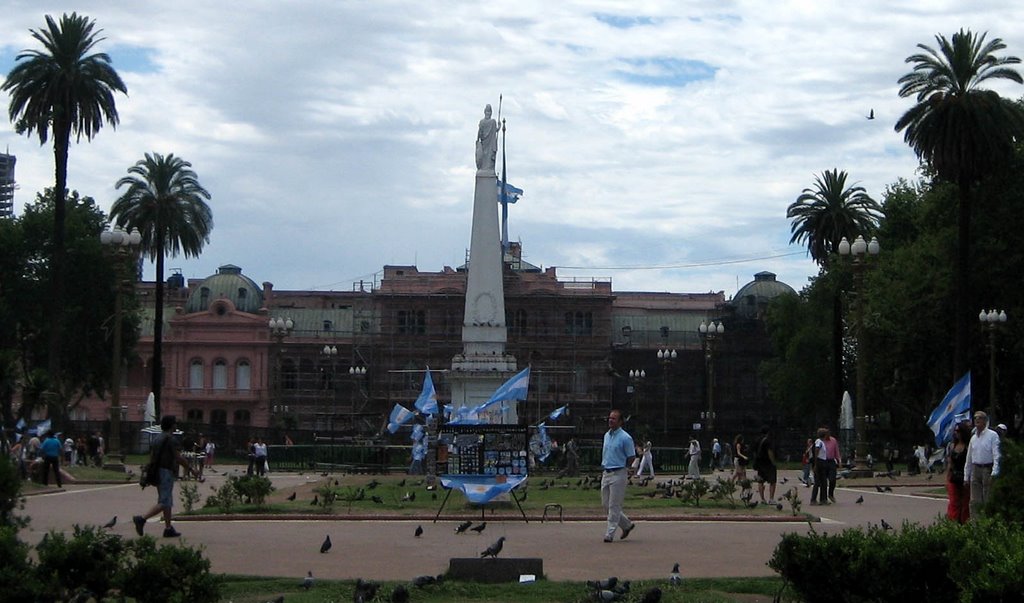
The Plaza de Mayo is Buenos Aires's main square. It's right in front of Argentina's "White House", known as the Casa Rosada [Pink House]. The police had erected barriers across the end of the plaza near the Casa Rosada to prevent protests.
The area surrounding the Plaza de Mayo has office buildings for various government agencies and private businesses. We saw an interesting end-of-the-year tradition: office workers throw armloads of paper out the window, like giant confetti. It was the last workday of 2006 and papers filled the trees and made drifts along the curb.
Labels: Argentina, Buenos Aires
archives
- June 2006
- July 2006
- August 2006
- September 2006
- October 2006
- November 2006
- December 2006
- January 2007
- February 2007
- March 2007
- April 2007
- May 2007
- June 2007
- July 2007
- August 2007
- September 2007
- October 2007
- February 2008
- March 2008
- April 2008
- May 2008
- July 2008
- August 2008
- September 2008
- October 2008
- February 2009
- April 2009
- July 2009
- December 2009
- April 2010
- February 2012
- March 2023
- April 2023
- February 2026


