Friday, April 07, 2023
Argentine pesos

It's not always this way, but the value of the Argentine peso is falling faster than prices inflate so nearly everything here is a bargain for anyone with foreign currency.

In Uruguay, everyone had their trusted exchange guy in Buenos Aires-- a taxi driver, a white-haired man operating next to a florist, a guy who would deliver pesos to your door-- and they were happy to share their contacts. We have been changing money at the black market rate in an office on a big commercial street-- complete with two teller windows, marble floors, frosted glass dividers, velvet ropes between chromed stanchions, and bill-counting machines. It's not secret-- there is a big lighted sign above the entrance and the name is etched on the glass double doors. Apparently the black market is fairly grey.
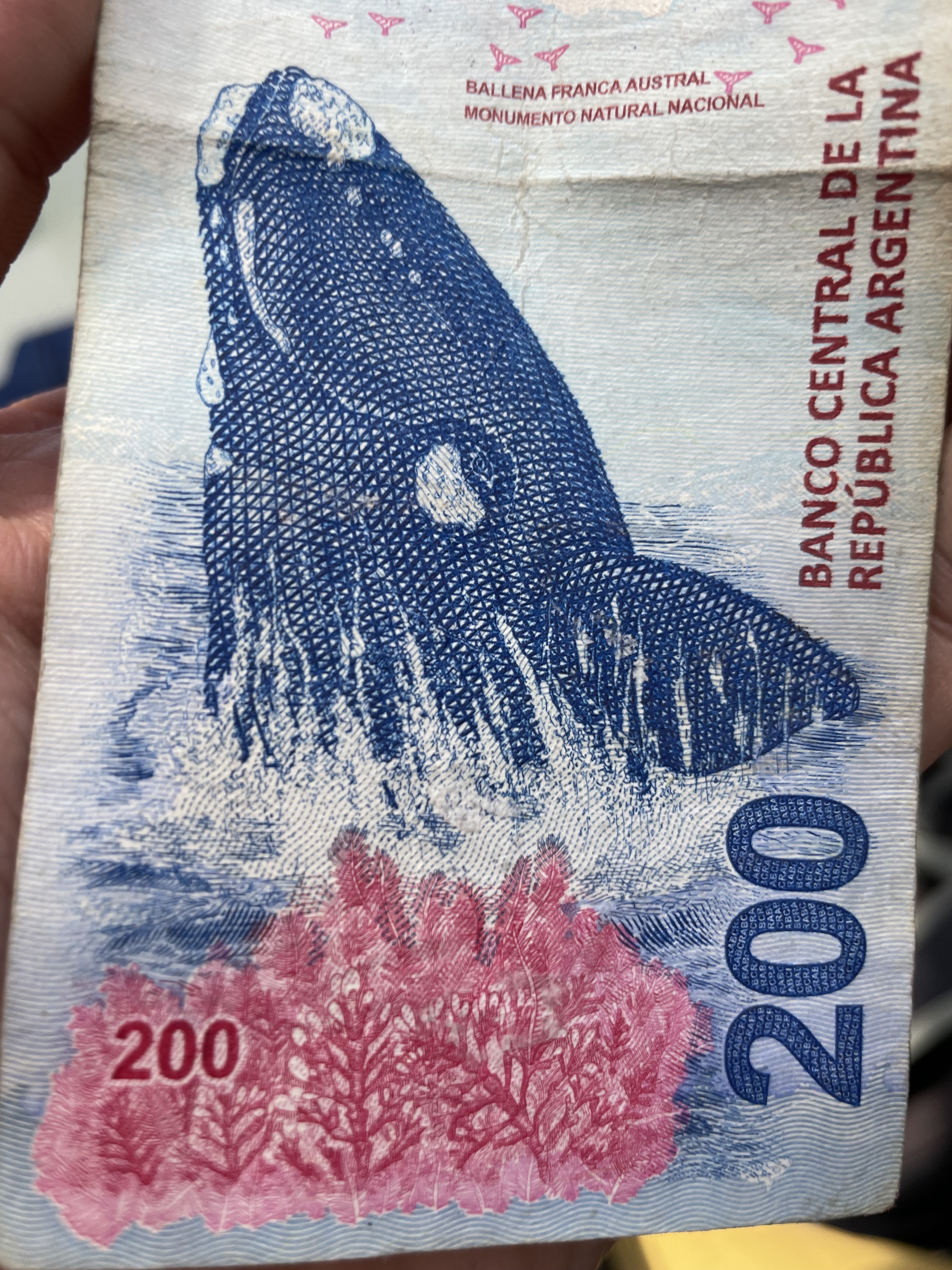
The biggest bill in circulation is 1000 pesos-- only worth $2.50 US-- so paying for a hotel requires bundles of bills. Even buying dinner means counting stacks of dozens of notes. The smaller bills (10, 20 pesos) have so little value that they are often ignored at cash registers. Western Union was running short of 1000 peso bills, so customers were stuffing thick wads of 100 peso and 500 peso notes into pockets, purses, and paper bags that held the croissants they ate while waiting in line. An inch thick stack of 100 peso bills makes you feel rich, but its only worth about $25.
While Argentine products are super-cheap now, imports are really expensive here. A bottle of maple syrup cost over $70 at the official exchange rate. Ordinary salmon from Chile costs 4 times as much as prime Argentine streak. My wife is particular about coffee and much of the South American coffee doesn't meet her standards (wrong beans, processed with sugar) so she looked for imported coffee in the supermarket but it was simply unavailable. The same exchange rate that makes Argentina a bargain for us, makes imported good prohibitively costly.
Inflation is currently running over 100% annually. Many restaurants cover the old prices with stickers rather than re-print the entire menu. We ate a Don Julio, a famous steakhouse, and received menus with two different prices-- one was from last week and prices had already changed. We took the Mitre train to Tigre (about an hour's ride)-- a comfortable modern train-- and it cost 25 pesos, about 6 cents. Apparently government-set prices don't adjust as quickly as restaurants.

As a traveler, the huge difference between the black market and official exchange rates means you need to manage your cash carefully. Withdrawing from an ATM is at the official rate-- doubling your costs. Credit cards may exchange at the official rate or at a special tourist rate (close to the black market rate) but it's impossible to know at the time of a purchase. There isn't much dollarization (it may be illegal) so cash transactions in pesos are the norm. This means regular trips to a change dollars. There is a strong preference for crisp, clean US $100 bills. Worn currency or smaller bills may trade at a discount or be rejected entirely.
But, it's important not to exchange more than you will spend, since you can't change the pesos back into dollars. (Everyone wants dollars and no one wants to hold pesos.) The value of the peso is dropping quickly so they are likely to be worthless for travel in future years. Pretty much use it or lose it.


Wednesday, June 13, 2007
Price discrimination 2
 A few months ago I posted on the difference between prescription drug prices in Uruguay and the United States. Here's a different example:
I wear a lot of casual clothes from Columbia Sportswear. They're durable, relaxed, and good for camping and traveling. In the US, I can buy a pair of Columbia pants for about $30 at Kohls. In Montevideo, there's a Columbia store right around the corner from my apartment. Same rugged outdoor clothing, but the prices are different. Instead of $30-$40, the pants cost $90 or $100.
Why such a big difference? Part of it is taxes. In Michigan the price doesn't include sales tax, so I could add a couple of dollars to adjust for that. Uruguay's IVA is higher, so it probably accounts for $20 of the price differential, but that still leaves a 100% difference. Why?
Production costs won't explain the difference-- the clothes are imports to both countries. We could look at differences in demand. But here the story becomes less simple, why charge a substantially higher price in a poorer country?
I'd suggest it has to do with an absence of competition. In the US, Patagonia dominates the high-end outdoor clothing market but they have little presence in Uruguay. That lets Columbia re-position itself locally to become the luxury outdoor brand. Rather than compete against LL Bean and Woolrich in the middle-price market segment like they do in the US, they hope to command a premium price in Uruguay. Will it work? I'm not sure. I don't see a lot of traffic in their boutique, but their pricing would allow them to profit on low volume.
Would I pay $100? No, I'm not that loyal a customer. But if I were staying here longer, they might be a pedido.
Labels: business, economics, Uruguay
Saturday, April 28, 2007
A Beautiful Mind in Uruguay
 Sylvia Nasar, author of "A Beautiful Mind," visited Uruguay to speak at the Universidad de Montevideo. We enjoyed her talk Thursday evening and had the pleasure of accompanying her and her son on an afternoon at the San Pedro de Timote estancia.
Labels: economics, rural, Uruguay
Wednesday, April 25, 2007
Gauchos and Money
 The Museo del Gaucho and the Museo de la Moneda occupy separate floors in the same late-nineteenth century mansion in Montevideo's Centro, so you get two museums for one price-- free. Both collections are fairly small but interesting.
 The gaucho museum showcases the elaborate silverwork used by the caballeros on saddles, belts, knives, whips, and bridles. It also displays weapons, mates, canteens made from horns, and traditional clothing of the countryside.
As an economist, I was fascinated by the display of currency from the early 1990s. Those bills looked just like the ones in circulation today but they had a lot more zeros: today's 20 peso note was 20,000 nuevo pesos at that time. All the bills kept the same design: colors, portrait, artwork but with three fewer zeros. Another display case had currency from the 1970s before the introduction of the nuevo peso-- and again those bills had an extra 3 zeros. My favorite was this one where they changed a 5000 peso note to a 5 nuevo peso note using a rubber stamp.
As a result of these currency changes, today's 1 peso coin represents one million old pesos. This made the old pesos (through the 1970s) and the nuevo pesos (through the early 1990s) essentially worthless. (I have seen people use them as chips when playing truco and the Almacén del Hacha has jars full of them as decoration.) Why? Uruguay, like other countries in the region, experienced runaway inflation.
If you're not interested in money or gauchos, you might still enjoy visiting the museum to see the elaborate housing that Uruguay's elite enjoyed a century ago.
Avenida 18 de Julio 998. Open Monday-Friday 10 am - 5 pm. Free.
Labels: economics, Montevideo places, museums, Uruguay
Wednesday, March 21, 2007
Power of the Press
From El Pais:
"Remesas a Uruguay fueron de U$S 115:
Se prevé que sigan creciendo; en 2006 subieron un 62%
El envío de remesas a Uruguay "continuará creciendo" en el futuro debido a la suba en la emigración y a la "propensión" de las personas fuera del país a volcar dinero hacia su país, según el estudio Remesas en Uruguay de los economistas Fernando Borraz y Susan Pozo a cuyas conclusiones accedió El País."
From El Espectador
AUMENTARON REMESAS DE URUGUAYOS
Lo bien que viene
20.03.2007
Los uruguayos radicados en el extranjero enviaron a sus familias remesas por 115 millones de dólares en 2006, lo que significa un incremento del 62 por ciento en comparación con 2005, de acuerdo a un estudio difundido.
En 2005 las remesas enviadas desde el exterior por los uruguayos ascendieron a 71,3 millones de dólares.
Según el estudio realizado por los economistas Fernando Borraz y Susan Pozo y difundido por El Espectador, al menos en un 2 por ciento de los hogares uruguayos se reciben remesas.
My wife is a bit upset by the errors. She and her co-researcher spent a good part of the day trying to contact the media and make corrections, without much success.
EL Pais does plan a longer article on their research in a few weeks.
Tuesday, January 23, 2007
Globalization in a Box
 I associate the port of Montevideo with grilled meats, but it is a working port. Stacks of containers tower over the Rambla and the Río. From my apartment, I can almost always see a few big containerships waiting for a berth.
 I just finished reading a book by Marc Levinson, The Box: How the Shipping Container Made the World Smaller and the World Economy Bigger, which argues that containerization made globalization possible.
"Barbie was conceived as the all-American girl. In truth, she never was... Workers in China produced her statuesque figure, using molds from the United States and other machines from Japan and Europe. Her nylon hair was Japanese, the plastic in her body from Taiwan, the pigments American, the cotton clothing from China. Barbie, simple girl though she is, had developed her very own global supply chain. Supply chains like Barbie's are a direct result of the changes wrought by the rise of container shipping."While shipping containers don't have the same glamour as high-tech electronics, their impact on the world economy has been as big.
(If you're interested, Princeton University Press presents the first chapter of The Box free.)
Containerization could help Montevideo, but it's not a sure thing. Montevideo's port is deeper and closer to the ocean than the port in Buenos Aires. Uruguay would like it to be the center of regional shipping.
From theADMINISTRACIÓN NACIONAL DE PUERTOS website:
"The Port of Montevideo is located on the River Plate, and geographically positioned as the main cargo transport route of Mercosur. It has become an axis of integration for the region, due to its immersion in the area of influence of almost 200 million inhabitants with the highest per capita income of Latin America.
Since very early in its inception, the Port of Montevideo has played a key role in the country and region's development. Because of its excellent location, its competitive advantages in terms of natural characteristics and infrastructure, its services and investment opportunities, it has become a necessary reference in commercial routes."
The economics of ocean shipping have been changing in favor of mega-ports, which may limit the growth of Montevideo's port. I've read calls for a big container port on the Pacific coast (Chile) that would serve all of South America. The continuing blockade of Uruguay's bridges by Argentine protestors also hurts its potential as an intermodal freight center.
Labels: economics, Montevideo places, Uruguay
Tuesday, December 26, 2006
Santa doesn't come to every house
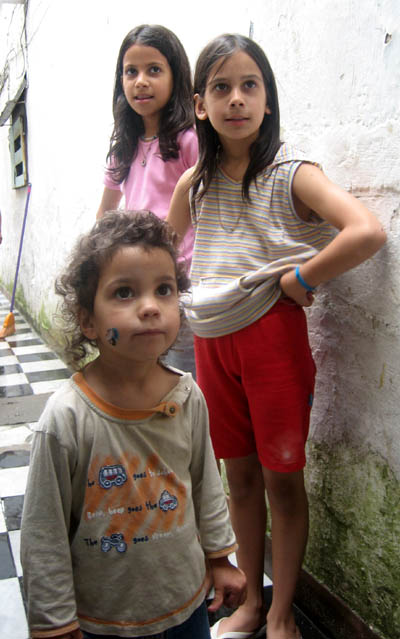 The Asociación Cultural y Casa de los Inmigrantes César Vallejo collected Christmas wishes from poor childern in Montevideo and looked for donors to help. El Pais ran an article on the unmet requests a few days before Christmas.
 We called the agency and read a few of the kids' letters. One note said,"Mr. Papa Noel, This year I have been good. Would it be possible to bring me a doll?" And another said, "Dear Papa Noel: I would like a soccer ball because I like sports very much and a pair of sneakers." We did a little shopping and delivered gifts directly to a few kids on Christmas eve. They were delighted.
Living in the US, I've been fortunate to have never been in the situation where I couldn't buy a gift for my own children. (Our problem tends to be the opposite: we have so many things we can't store them all.) Economists may argue that direct gift-giving is inefficient & that a cash transfer would be more efficient, but writing a check doesn't make the same emotional connection. I was really touched seeing these kids.
It's made me think differently about the holiday season. For instance, while I love electronic gadgets, after visiting these poor children I can't read this high-tech wish list without a touch of queasiness.
Labels: economics, holidays, Uruguay
Wednesday, December 06, 2006
Global Wealth
Uruguay's net worth per capita was $11,807 (based on current exchange rates.) For comparison, the US net worth per capita was $143,727. Japan had the highest net worth at $180,837.
Some other Latin American countries (net worth per capita, in US $):
Argentina 25,410
Brazil 9,566
Chile 13,722
Dominican Republic 5,713
Mexico 13,070
Venezuela 10,101
A couple of notes:
1. The data is from 2000, so it doesn't fully reflect the regional economic crises.
2. Wealth is also not distributed evenly within a country, so these figures don't necessarily reflect a "typical" person's wealth.
3. These figures don't account for differences in price levels in different countries. The full report does include purchasing power parity numbers. (For these Latin American countries, PPP-adjusted measures of wealth are substantially higher. For Japan, the PPP wealth measure is much lower because of the high prices in that country.)
This map (pdf) gives a quick overview. See the press release (pdf) or the full report(pdf) for more detail.
Friday, November 10, 2006
Recommended reading
These books aren't about Uruguay, but they are interesting. I built the list to help in a charitable effort of Seth Godin's blog
Here's the one day challenge: go build a holiday lens [and] have all the royalties earmarked for Room to Read. If every reader of this blog and every lensmaster on Squidoo builds just one lens today, we'll create tens of thousands of lenses, each donating money every day to build new schools. It only takes a few minutes...
Labels: economics
Wednesday, November 01, 2006
In the news
CIUDAD BARRIOS, El Salvador -- This lively mountain town survives on money sent from its sons and daughters living in the U.S. On days payments arrive, lines at the local credit union can reach 150 deep. The crowds then hail motorcycle taxis and head for the town's open-air market to stock up on food and clothing, or browse tiny appliance stores stuffed with blaring televisions and stereos.
It's the sort of scene that many development economists believe could transform some of the world's most impoverished regions, by putting cash directly in the pockets of the poor. With tens of millions of migrants around the globe sending remittances home, the flood of money has grown immense -- $167 billion last year, according to the World Bank.
In recent years, her work has focused on the economics of remittances in various countries. Currently, she is researching remittances to Uruguay with colleages at the Universidad de Montevideo, with support from the Fulbright Scholar Program.
Monday, October 30, 2006
Made in USA
Anonymous said...
Another good thing about an FTA with the states for Uruguay is that hardly any products are made in the US any more. We buy everything from other places, mostly China...
As an economist, I know this statement isn't true. Imports are only about 14% of US national income. In the US, most spending is on US-produced goods and services. European countries, by comparison, spend substantially more on imports: France 24%, Germany 29%, Spain 27%. It’s true that imports have increased in recent decades, but the US is still a domestically-focused economy.
Living in Uruguay, when I read the comment, made me realize how few US-made products are available here. While I can buy lots of US brands, they are manufactured in other countries: Oreo cookies from Argentina or Coca-Cola bottled in Uruguay. Kellogg’s cereal, Lay’s potato chips, Ford cars, Budweiser beer, and M&M candies are all available in Montevideo, but they aren’t imported from the US. They are produced by foreign subsidiaries of the US companies.
I started looking, in Uruguay, for products made in the US. I ran into many other familiar brands: Canon, Nestlé’s, Hellman’s, VW, SONY— but these aren’t even US brands, just well-known global brands. There’s a Nike shop selling sneakers at the mall, but Nike outsources all of its manufacturing, so I didn’t even look for a “Made in USA” label there. The old cars on the streets— a 1968 Dodge Polara, Pre-WWII Chevy trucks, Ford Model A’s— may have been produced in the US, but that’s economic history. I wanted to find something produced in 2006.
This sign at the shopping mall woke me up. I’d been making the same mistake the anonymous commenter made— thinking inside the box. Huge amounts of what we consume aren’t physical things and they don’t come in boxes. Everyday, I see US shows on Uruguayan TV. The theaters in Montevideo show the latest Hollywood releases. There are US banks throughout the city. Of course this is true in the US as well. Walk into a Walmart and you could get the impression that the US doesn't make anything. But we spend more on housing, education, and entertainment than we do at Walmart. Former Fed chairman, Alan Greenpan spoke famously about the "dematerialization" of the US economy. While, I wouldn't want to push this too far, it is important to remember that not everything of value fits in a shopping bag.
Labels: business, economics, Uruguay
Tuesday, October 24, 2006
UNESCO in Montevideo

We got a note saying that UNESCO will be testing the students at my daughter's school this week, as part of a study of educational achievement in Latin America. The tests will be administered by technicians from the UN agency. I'm sure the results won't be ready for a year or more, but I was curious to see what else UNESCO had done.
I found this page on education Statistics on Uruguay.
And a map comparing high-school enrollment across the world. Uruguay, Brazil, and Chile are in the second-highest tier (along with the US) at 80-95%. Most other Latin American countries are a level, or two, lower. Western Europe, Canada, Australia, and Japan are at the highest level (above 95%.)
Thursday, October 19, 2006
Sign of the times
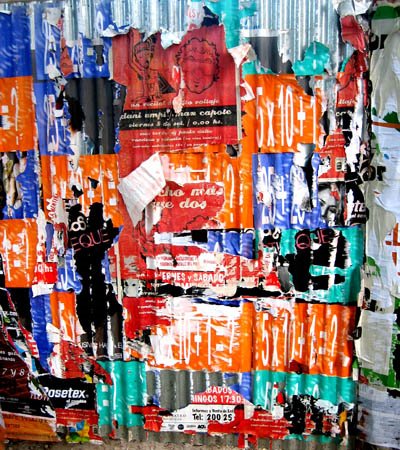
Posters cover the fences at construction sites in Montevideo. Since there are so many pedestrians, it's an effective method of advertising. In the US suburbs, where no one walks, the posters would be invisible.
Friday, October 13, 2006
More Nobel news
Paul Sinclair describes how Professor Yunus began:
One day he met an impoverished single mother of three named Sufia Begum, working to weave bamboo stools, morning to night whilst living in utter destitution.
“Do you own this bamboo?” he asked her.
“Yes”.
“How do you get it?”
“ I buy it.”
“ How much does the bamboo cost you?”
“5 Taka” (22 cents US).
“Do you have 5 Taka?”
“No, I borrow it from the Paikars.”
“The middlemen?” he asked. “What is your arrangement with them?”
“I must sell my bamboo stools back to them at the end of the day so as to repay my loan. That way what is left over to me is my profit"
“How much do you sell it for?”
“Five Taka and 50 Paisa.”
“So you make 50 Paisa profit?"
She nodded. That came to a profit of just over 2 US cents.
"And could you borrow the cash and buy your own raw material?"
"Yes but the money lender would demand a lot. And people who start with them only get poorer."
“How much do the money lenders charge?”
“It depends. Sometimes they charge 10 percent per week. I even have a neighbour who is paying 10 percent per day".
“And that is all you earn from making these beautiful bamboo stools, 50 Paisa?
“Yes.”
The Professor watched as Sufia set to work again, because she did not want to lose any time, her small brown hands plaiting the strands of bamboo as they had every day for months and years on end.
He had never heard of someone suffering so much for the lack of 22 US cents. The Professor thought Sufia’s status as virtually a bonded slave was never going to change if she could not find that five taka to start with. Credit could bring her that money. She could then sell her products in a free market and she could get a much better spread between the cost of her materials and her sale price.
The Grameen bank has grown to be an international network, including Grameen Uruguay. Other organizations have been inspired by the Grameen model and there are even commercial banks making microcredit loans.
update: Read an opinion piece by Muhammad Yunus in the Wall Street Journal
[see this post on Monday's Economics Prize.]
The check still isn't in the mail

More bills to pay, but Redpagos payment centers [see this post] aren't for all the bills. Today I had to pay gastos comunes (condo fees), the Montevideo "door tax", and the phone/Internet bills. These are all paid, in cash, at the Abitab office, just up the street. I'm not sure why there are two payment networks, but I noticed one difference. At Redpagos, you can exchange dollars for pesos. At Abitab, you can buy lottery tickets.
Labels: business, economics, Uruguay
Monday, October 09, 2006
Nobel Prize in Economics
Low unemployment and low inflation are central goals of stabilization policy. During the 1950s and 1960s the view of a stable tradeoff between inflation and unemployment was established, the so-called Phillips curve. According to this, the price for reduced unemployment was a one-time increase of the inflation rate. Phelps challenged this view through a more fundamental analysis of the determination of wages and prices, taking into account problems of information in the economy. Individual agents have incomplete knowledge about the actions of others and must base their decisions on expectations. Phelps formulated the hypothesis of the expectations-augmented Phillips curve, according to which inflation depends on both unemployment and inflation expectations.
Essentially, Phelps said there is no long-run trade-off between unemployment and inflation. (Milton Friedman, the 1976 Nobel laureate, developed a similar argument. Their ideas are often combined as the Friedman-Phelps hypothesis.) This has had a great impact on macroeconomic policy, since most policy tools exploit the short-run trade-off between inflation and unemployment. Stimulative fiscal or monetary policies tend to increase inflation in order to reduce unemployment. Phelps argues these policies are only effective when people don't expect inflation. As people experience high inflation rates, they anticipate continuing high inflation rates. Policy-makers are then in a worse position-- spiraling inflation even with high rates of unemployment.
This a situation that many South American countries faced during the 1970s and 1980s. Ben Bernanke, now the Chair of the US Federal Reserve, wrote:
For those of us here in the United States, acclimated as we have become to price stability, the severity of inflation in many Latin American countries in recent decades may be difficult to comprehend. A measure of price changes in nine of the most populous Latin American countries shows that inflation in the region averaged nearly 160 percent per year in the 1980s and 235 percent per year in the first half of the 1990s. Indeed, high inflation morphed into hyperinflation--conventionally defined as inflation exceeding 50 percent per month (Cagan, 1956)--in a number of Latin countries during the latter part of the 1980s and in the early 1990s. Brazil's inflation rate, for example, exceeded 1,000 percent per year in four of the five years between 1989 and 1993. Other Latin American countries suffering hyperinflations at about that time included Argentina, Bolivia, Nicaragua, and Peru. A particularly striking aspect of this poor inflation performance is that it occurred while most of the rest of the world was reducing inflation to low levels.[See Inflation in Latin America: A New Era?]
This level of inflation is unsustainable and usually leads to some kind of economic crisis. Policies designed to control this inflation can also cause tremendous economic hardship. Uruguay, like many of its neighbors, has suffered from both.
According to Phelp's work, low-inflation policies, while painful, may be a worthwhile long term investment. Whether populist governments are willing to make that investment remains to be seen.
update: The Wall Street Journal has a new opinion piece by Phelps on Dynamic Capitalism
Thursday, October 05, 2006
Energy diet
Flipping channels, I came across the news that Bill Clinton’s Global Initiative had just ended with Richard Branson, the British mogul, pledging $3 billion to fight climate change over the next decade. On another channel, Mayor Bloomberg stood at a podium in California and announced, to my pride and delight, his sweeping eco-initiative for New York: the city’s carbon emissions would be measured, an Office of Long-Term Planning and Sustainability would be created. Meanwhile, the man standing next to him, Governor Schwarzenegger, was set to sign legislation to reduce greenhouse gas emissions for his state — the world’s 12th largest contributor of such gases — at a level the federal government had continually rejected. Everyone was chipping in, even Arnold, the first civilian ever to drive a Hummer. I took another bite of doughnut.
And that’s when it came to me. I should go on a diet.
A half-ton diet.
I knew, having taken the “Calculate Your Impact” survey on climatecrisis.net, the companion Web site for the Gore movie, that our household produced some 19,100 pounds of CO2 last year, 4,100 pounds more than the national average...
As a family, as a household, couldn’t we drop a half-ton, a mere 5 percent of our weight?
Andrew Postman's attempts to reduce his energy consumption made me think about how much less energy my family uses in Uruguay. We've gone from two cars to none (at least for now). Our apartment is maybe a third the size of our house in Kalamazoo, so heating costs are lower. Radiant slab heating is more efficient than forced-air heat and winter in Uruguay is much, much milder than winter in Michigan. The oven here is less than half the size of our Kalamazoo oven-- again more efficient. Our refrigerator, big by local standards, is about two-thirds the size of the fridge in our kitchen (and we have a second full-size fridge in the basement there). The washer here is a tiny front-loader. No dryer, so a big energy savings. In Michigan, we usually have 3 desktop computers running (between home and offices); now we just turn on the laptops when we need them.
Energy conservation is the norm in Montevideo. Motion sensors control the hall light outside my apartment door. Compact florescent bulbs are common. Nearly all the cars are small and many residents rely on public transportation. I can't claim to be doing anything special.
And, the flight to Montevideo wipes out much of the savings. According to the “Calculate Your Impact” survey, my flight (one-way) created a full ton of carbon dioxide per passenger.
Wednesday, September 27, 2006
Bankers' Hours

Banks in Montevideo are open weekdays from 1pm to 5pm. The photo shows people waiting to do business at 1:00 this afternoon. The US used to have very limited bankers's hours as well-- from 10:00am- 3:00pm, if memory serves. The tradition of short banking hours goes back to the era of hand calculations. The banks needed time to manually add up their accounts and to balance their books. Modern banking is all electronic, so calculations are done in real time. That's true here as well. This bank is fully-outfitted with computers, ATMs, online banking, etc. Yet, it and its competitors are only open a few hours a day. I don't know if it's merely customary or some kind of government regulation. As a customer, it's not particularly convenient.
Global Competitiveness
Chile, 27th, is the highest ranked Latin American country. They said:
Chile’s position reflects not only solid institutions – already operating at levels of transparency and openness above those of the EU on average – but also the presence of efficient markets that are relatively free of distortions. The state has played a supportive role in the creation of a credible, stable regulatory regime. Extremely competent macroeconomic management has been a critical element in creating the conditions for rapid growth and sustained efforts to reduce poverty. The resources generated by Chile’s virtuous fiscal policy have gone to finance investment in infrastructure and, increasingly, education and public health. Given Chile’s strong competitive position, the authorities will have to focus attention on upgrading the capacity of the labour force with a view to rapidly narrowing the skills gap with respect to Finland, Ireland and New Zealand, the relevant comparator group for Chile.
The text of the report doesn't discuss Uruguay. There is a substantial discussion of "Argentina's unfulfilled potential" (Box 6) that characterizes Argentina's growth performance as one of high volatility, sharp oscillation, with a clear pattern of boom and bust. The whiplash of its larger neighbor has had major economic effects on Uruguay.
Uruguay had a relatively high rank on Institutions (42) (this category includes property rights, security, ethics, government), and on Education and Infrastructure measures (55-59). Uruguay scored relatively poorly on Macroeconomics (109) and on Market Efficiency (116)(a category that includes subsidies, degree of competition, and trade barriers.)
Other Latin American countries scored substantially lower.
A lack of sound and credible institutions remains a significant stumbling block in many Latin American countries. Bolivia (97), Ecuador (90), Guyana (111), Honduras (93), Nicaragua (95) and Paraguay (106) achieve low rankings overall and, in particular, are among the worst performers for basic elements of good governance, including reasonably transparent and open institutions. These countries all suffer from poorly defined property rights, undue influence, inefficient government operations, as well as unstable business environments. Perceived favouritism in government decision-making, an insufficiently independent judiciary, and security costs associated with high levels of crime and corruption make it difficult for the business community to compete effectively.
Global Competitiveness Report 2006-2007
Monday, September 25, 2006
drugs

Nexium is probably best known for its purposively uninformative advertisements. The ads weren't misleading, but the only information in them was the color of the pill (purple). They didn't say anything about what the medication could do or what symptons it could treat, just "ask your doctor..." (See this story on marketing Nexium.) (Another article discusses their broader marketing strategy.)
I take these pills for acid reflux.
In the US, it's a prescription medicine and I was afraid I'd have trouble refilling it in Urugay. No problem; it's an over-the-counter drug here, so I was easily able to buy it. And it was much cheaper here than in the US. A month's supply of Nexium costs about $50 here compared to $200 in Michigan.
A 400% price difference is enough to interest an economist.
Cost differences between Uruguay and the US can't explain the difference because Nexium is produced by AstraZeneca, a Swedish multinational pharmaceutical firm with headquarters in London. Their principal manufacturing facilities are in rich industrialized countries-- Western Europe, USA, Japan, Australia-- with roughly comparable costs.
The price differential must come from differences on the demand side of the market. The US is richer than Uruguay, and its consumers have a higher ability to pay. Charging a higher price in the US and a lower price in Uruguay gives the firm higher profits than charging the same price in both countries. This practice is known as price discrimination. Price discrimination only works if a firm has monopoly power, which AstraZeneca has through its international patents. The other factor needed for successful price discrimination is the ability to prevent re-selling between separate market segments. This is why the pharmacuetical industry fights so hard against drug imports.
Another relevant economic concept is the principal-agent problem. When someone else pays the bills, the decision-maker is less likely to be sensitive to price. In the US, my physician prescribed Nexium, because he believed it would be effective. (And it was.) But, of course, the doctor didn't have to pay for the medication. (First principal-agent problem.) Because I have health insurance that covers a substantial part of my prescription medication, I also don't pay the full cost. (Second principal-agent problem.) If had to pay the full $200 cost for Nexium in the US, I'd probably ask my doctor if Prilosec, or another inexpensive substitute, would work for me. Because of the insurance, I pay less for the expensive Nexium in the US than I pay for the much cheaper Nexium in Uruguay.
archives
- June 2006
- July 2006
- August 2006
- September 2006
- October 2006
- November 2006
- December 2006
- January 2007
- February 2007
- March 2007
- April 2007
- May 2007
- June 2007
- July 2007
- August 2007
- September 2007
- October 2007
- February 2008
- March 2008
- April 2008
- May 2008
- July 2008
- August 2008
- September 2008
- October 2008
- February 2009
- April 2009
- July 2009
- December 2009
- April 2010
- February 2012
- March 2023
- April 2023
- February 2026