Monday, December 28, 2009
Gaucho music

Here's a video from an evening of música folclórica in homage to a gaucho poet. The performance was held in the Cabildo de Montevideo.
Labels: music, rural, Uruguay, video

Saturday, April 19, 2008
Uruguay viejo
 Living in Uruguay, it was easy to see traces of its past: architecture from previous centuries, colonial fortresses, and antique cars still in use. Some are a bit worn, others in states of decay, and others fully renovated. In any state, they were interesting reminders of Uruguay's history.
I made a video slideshow of photos of artifacts from Uruguay's past. You can see it here:
Labels: Colonia, interior, Montevideo places, rural, Uruguay, video
Friday, March 21, 2008
Semana Criolla

This week other Latin American countries celebrate Semana Santa and Uruguay enjoys its Semana de Turismo with events throughout the country. In Montevideo, gauchos compete on horseback during Semana Criolla. Riders, called jinetes, ride wild horses. They are amazingly good.
I put together a video slideshow from last year's Semana Criolla competitions. You can watch it here:
Earlier, I posted short videos of Semana Criolla at Parque Prado and at Parque Roosevelt.
Labels: rural, sports, Uruguay, video
Friday, June 22, 2007
El Campo

It's a rainy day in Montevideo so I decided to put together a little video from Uruguay's countryside. The clips are from my visits to two working estancias: Estancia Las Cecilias and Estancia Los Morteros. Like my Montevideo series, this video isn't of a particular event but rather a general look at the campo.
My earlier rural videos include: weighing sheep, making sausage, and rodeo.
Here's today's video:
Labels: interior, rural, Uruguay, video
Friday, June 01, 2007
Frigorífico
 Wednesday morning at 4 am I left Montevideo in order to visit a frigorífico in Paso de los Toros. We arrived at the meat packing plant just after sunrise, around eight in the morning. We changed into white pants, white tunics, white rubber boots, and blue hardhats before entering the plant. In the entryway, everyone scrubbed their boots and washed their hands before going into the packing room.
The plant was much smaller than the typical Uruguayan frigorífico and it was designed for processing liebre (hare) and later expanded to sheep. The day we were there they were packing lamb for sale in Africa.
I'd never been to a slaughterhouse so I didn't know what to expect. The part of the plant we were in was like a big busy butchershop-- very clean, very bright-- meat being cut, packaged, vacuum sealed, and boxed
See a short video:
Labels: food and drink, interior, rural, Tacuarembó, Uruguay, video
Friday, May 25, 2007
Ñandú
 The ñandú [South American ostrich] may be my favorite animal in Uruguay. I've seen them many times driving through the countryside and it's always a treat. Last weekend at the Estancia los Morteros I stood quietly beside a fence and a pair of them came within 50 feet of me. Very cool!
Related posts:
Ñandú is good to eat;
Their eggs are huge.
In Patagonia we saw their smaller relatives, the choique
Labels: interior, Lavalleja, nature, rural, Uruguay
Wednesday, May 23, 2007
Making Chorizo
 Once a year at the Estancia Los Morteros they make their own chorizo. Usually it's a mid-Winter activity (June or July) but the pigs had been troublesome this year so they decided to move the process to the weekend we visited. It was interesting to see and a good reminder that meat doesn't ultimately come from the supermarket.
 None of the pig was wasted; most of it became chorizo, but the legs were salted to make ham and we ate delicious spareribs for dinner. A couple of big pots simmered on the fire for head cheese. The skins cured on the shed roof and the dogs ate the scraps. The chorizo, cooked slowly over embers, was great.
If you don't follow the dictum, "people who love sausage and respect the law should never watch either being made," you may like this video:
Labels: food and drink, interior, Lavalleja, rural, seasons, Uruguay, video
Tuesday, May 22, 2007
Estancia Los Morteros

We had a great weekend with friends at their estancia in Lavalleja. It's in a beautiful part of the country, several miles from the nearest paved road. The land was planted in eucalyptus six years ago and now looks like a forest. Livestock graze under the trees. A dozen dogs and horses help manage the cows and sheep. A few pigs, chicken and ducks round out the animal life.
We got to watch chorizo being made-- from pig to parrilla. We ate tangerines straight from the tree to accompany fresh pork and cordero. The kids had a great time catching frogs in the pond and minnows in the creek and they were unhappy when they found the critters couldn't return to Montevideo as pets. The star-filled night sky was impressive.
We were all a bit sad when we had to return to the city. Now we have several loads of muddy clothes to wash.
See a photo album from the estancia
Labels: interior, Lavalleja, rural, Uruguay
Saturday, May 05, 2007
Fiesta del Caballo
 The Fiesta del Caballo is another horse event at the Parque Prado. It's much smaller than the Semana Criolla or the Expo Rural. It was so quiet my daughter thought the fairgrounds looked like a ghost town.
The Fiesta runs through next weekend, with a variety of horse competitions, lectures, and auctions. Admission is free.
See a short video.
Saturday, April 28, 2007
A Beautiful Mind in Uruguay
 Sylvia Nasar, author of "A Beautiful Mind," visited Uruguay to speak at the Universidad de Montevideo. We enjoyed her talk Thursday evening and had the pleasure of accompanying her and her son on an afternoon at the San Pedro de Timote estancia.
Labels: economics, rural, Uruguay
Monday, April 09, 2007
The other Semana Criolla
 Semana Criolla at Parque Prado seems to get all the attention but for 30 years there's been a second Semana Criolla festival at Parque Roosevelt. This location also features wild horses and jinetes, music, food and shopping. In addition they bring amusement park rides to Parque Roosevelt. The Lion's Club started the festival for people in Montevideo who couldn't afford to travel during Semana de Turismo.
Parque Roosevelt doesn't have the fairground infrastructure that the Prado has, so the event seemed more casual. Admission was free; parking cost 50 pesos and most people seemed to arrive by bus. The bleachers at the rueda were smaller so the audience was closer to the competition. We didn't stay for the evening entertainment but Araka la Kana was scheduled to perform on the outdoor stage that night.
See my video:
Labels: rural, sports, Uruguay, video
Saturday, April 07, 2007
Semana Criolla
 Besides the music and horse competitions, Semana Criolla at Parque Prado has folk dancing and lots shopping. It's a good place to buy all things gaucho: knives, boots, sombreros, or ponchos.
It's had lots of online coverage recently. The Miami Herald had a story and "This is Uruguay" had a nice blog post on gauchos and Gabo posted on Semana de Turismo.
Here's a video I made of Semana Criolla:
Labels: music, rural, sports, Uruguay, video
Thursday, April 05, 2007
Jinetes
 The horseback competition is the biggest attraction at the Semana Criolla. Riders compete in three categories a pelo [bareback], a basto [saddle] and a basto argentino [a mimimalist saddle]. The object is to stay on a wild horse for 12 seconds (or 10 seconds, if bareback) while the horse bucks and runs and tries to throw the rider. Jinetes [the riders] are judged on the quality of the ride-- my impression is the wilder the better. At times, the horse rolls on its back in an attempt to dismount the rider. More than half of the riders we saw were thrown before the time limit.
Jineteada was declared Uruguay's national sport in 2006.
Labels: rural, sports, Uruguay
Tuesday, April 03, 2007
A night at la Semana Criolla
 La Semana Criolla is Montevideo's main attraction during Semana de Turismo. It has rodeo events during the day and music in the evening. Like the Expo Rural, it's held in Montevideo's Parque Prado. We went in the evening, so the animals were in their stalls, but there was plenty of Uruguyan folk music and plenty of food.
 Here's a short music video from the event.
Labels: music, rural, Uruguay, video
Wednesday, November 22, 2006
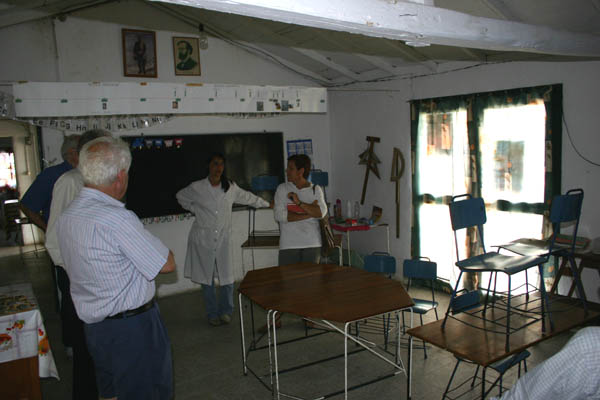
Escuela rural
 We visited this rural school on our way to the Estancia Las Cecilias. The students had left for the day and the teacher was leaving, but she graciously opened the school so we could see it.
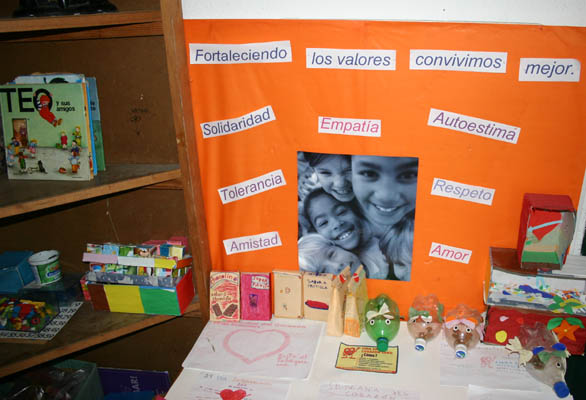
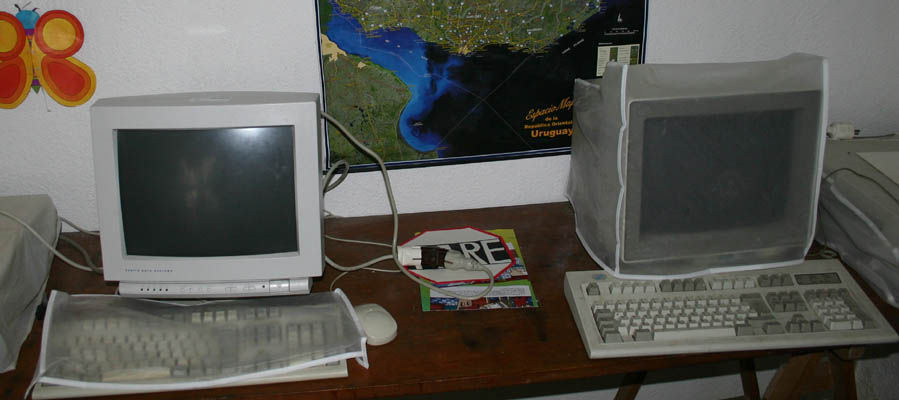
The school has one classroom and seven students, across all the elementary grades. The classroom has several tables, two computers, a timeline of Uruguay's history stretched across the room, and other student projects on display. In addition to the classroom, the school has two bathrooms, a large kitchen, and a bedroom for the teacher. There were two ostrich eggs (ñandú) on the kitchen table. Outside, there were chickens, a cat, and a lamb. The students' smocks and ties hung from hooks in the hallway.
Labels: Florida, interior, rural, Uruguay
Tuesday, November 21, 2006
Gauchos at work
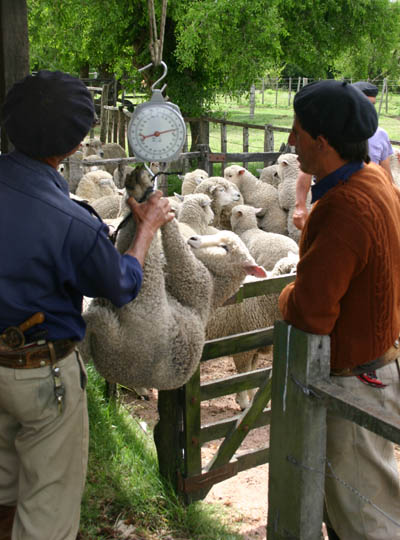
The Estancia Las Cecilias raises cattle and sheep.
Watch a short video of the gauchos weighing sheep:
Labels: Florida, interior, rural, Uruguay
Monday, November 20, 2006
Photos from Estancia Las Cecilias
Sunday, November 19, 2006
Estancia Las Cecilias
 I was a guest at the Estancia Las Cecilias for the last several days. It's a beautiful ranch on the Rio Yi, about 200 kilometers from Montevideo. I had a wonderful time. I went with friends and I had the pleasure of meeting several members of the family on the estancia. The grazing land was dotted with sheep, cattle, horses and the occasional ñandú. The food was great, as was the companionship. I took a lot of photos and a little video.
Labels: Florida, interior, rural, Uruguay, video
Monday, October 02, 2006
Expo Prado 2006
Uruguay's Expo Prado ended a couple of weeks ago and I posted descriptions earlier (See this post and this one.) If you're interested, you may like this short video/slideshow.
Sunday, September 17, 2006
Exposición Rural

Today is the last day of the Expo Prado. We enjoyed it enough that we visited again. We had a very nice lunch at the Hereford parilla restaurant. Several of the restaurants are white table cloth establishments with china plates, wine glasses, etc. Much nicer than anything I've seen at a U.S. fair.
The exhibit building from China featured a $20,000 (US) toilet/sink/bidet set. I'm sorry I didn't get a photo. Otherwise it had the same kinds of booths selling various products that many of the other countries had. The newspaper complained that the Chinese exhibits were all in English, with no Spanish.
The US exhibition did offer more than Pringles yesterday. A Country and Western band was singing. The cowboy hats and boots were Texas-style; the singers were drinking mate on break, so I'd guess they were local to Uruguay.
archives
- June 2006
- July 2006
- August 2006
- September 2006
- October 2006
- November 2006
- December 2006
- January 2007
- February 2007
- March 2007
- April 2007
- May 2007
- June 2007
- July 2007
- August 2007
- September 2007
- October 2007
- February 2008
- March 2008
- April 2008
- May 2008
- July 2008
- August 2008
- September 2008
- October 2008
- February 2009
- April 2009
- July 2009
- December 2009
- April 2010
- February 2012
- March 2023
- April 2023
- February 2026


